What’s the Chicago housing market like in 2026?
Chicago home prices are rising faster than in any of the 20 major metros tracked by the S&P Cotality Case-Shiller index, up 6.9% over the year to June 2026. Inside the city, the median sale price was $405,000 in August, up 8.0% from a year earlier, according to Illinois REALTORS. A shortage of homes for sale is behind it, which keeps sellers in the stronger position even with mortgage rates back above 7%.
Those headlines hide a lot of variation. The city, the suburban Cook County towns, and the collar counties are moving at different speeds. Below is what the latest numbers show and what they mean for buyers and sellers across Chicagoland this fall.
Table of Contents
What’s happening with Chicago home prices?
Prices are up across the region, and the city is leading. The S&P Cotality Case-Shiller Index released August 25, 2026 showed Chicago with a 6.9% annual gain in June, ahead of New York (4.8%) and Cleveland (4.1%) and well above the national index (1.5%). June was the fourth straight month Chicago topped all 20 metros.
S&P’s analysts describe it as part of a years-long trend, with “housing markets in the Northeast and Midwest regaining strength while many Western and Sunbelt markets soften.”
Within the city limits the increase is steeper. Illinois REALTORS reported a Chicago median of $405,000 for August, up 8.0% from a year earlier, against $395,000 across the nine-county metro (up 5.3%) and $330,000 statewide (up 4.8%). That’s a smaller jump than July’s, when the city median hit $425,000, up 13.3%, per the association’s July release. Illinois REALTORS President Jeff Kolbus described August as “showing signs of a seasonal slowdown as summer ends, but demand continues to support higher home prices.”
Are condos or houses driving the increase?
Condos have carried more of the city’s gain lately. The Illinois Housing Market Forecast that DePaul University’s Institute for Housing Studies prepares for Illinois REALTORS breaks August 2026 down by property type:
• City condos and townhomes: $420,000 median, up 8.2% from August 2025
• City single-family homes: $369,950 median, up about 2%, after double-digit growth in July
• Single-family homes across the nine-county metro: $449,000 median, up about 7%
Condos and townhomes made up nearly two of every three city sales in August (1,208 of 1,907 closings), so they carry a lot of weight in any citywide number. The higher condo median doesn’t mean condos are worth more than houses. A citywide median blends very different housing across 77 community areas, so it tells you more about which homes sold that month than about what any one home is worth. Your comparable sales are the ones near your address.
Is Chicago a buyer’s or seller’s market?
Who has the upper hand in Chicago right now?
Sellers do. Redfin’s August 2026 report for Cook County put the county at about 3 months of supply, against roughly 4 nationally, and found that 43.2% of homes sold above asking, compared with about 24% nationally. Only 12.7% of active listings carried a price cut.
Months of supply measures how long the current listings would last at the current pace of sales if nothing new came on the market. By the common industry rule of thumb, about six months marks a balanced market, so Cook County sits well on the seller’s side.
Homes are still moving quickly, if a little slower than in July. City single-family homes spent 28 days on market in August, two more than a year earlier, and condos and townhomes spent 25 days, per the DePaul report.
| Chicago housing market snapshot | Figure | Period | Source |
|---|---|---|---|
| City of Chicago median sale price, all homes | $405,000, up 8.0% | August 2026 | Illinois REALTORS |
| City of Chicago homes for sale | 3,541, down 23.3% | August 2026 | Illinois REALTORS |
| Metro median sale price, all homes (9 counties) | $395,000, up 5.3% | August 2026 | Illinois REALTORS |
| City condo and townhome median | $420,000, up 8.2% | August 2026 | DePaul IHS |
| City single-family median | $369,950, up about 2% | August 2026 | DePaul IHS |
| Metro single-family median (9 counties) | $449,000, up about 7% | August 2026 | DePaul IHS |
| Cook County homes sold above asking | 43.2% (about 24% nationally) | August 2026 | Redfin |
| Cook County months of supply | about 3 (about 4 nationally) | August 2026 | Redfin |
| 30-year fixed mortgage rate | 7.03% | Week of Sept. 24, 2026 | Freddie Mac |
Why do Chicago home prices keep rising?
Why are Chicago home prices going up so fast?
Too few homes are for sale to meet steady demand. In August 2026 the city had 3,541 homes for sale, 23.3% fewer than a year earlier, while sales slipped only 2.7%, according to Illinois REALTORS. Across the nine-county metro, listings fell 11.0% against a 4.5% drop in sales, so buyers competed for a smaller pool.
DePaul’s Institute for Housing Studies shows the same squeeze by property type, with city single-family inventory down 29.5% and condo inventory down 19.0%. The shortage runs deeper than one season: DePaul’s report notes that Illinois has the second-lowest level of new housing construction per capita of any state.
Jeff Baker, CEO of Illinois REALTORS, told WTTW that the state’s shortage “would require us to triple the amount of new home construction every single year for the next five years, just to meet today’s demand.” Until more homes get built or more owners decide to sell, that imbalance keeps pressure on prices.
Are Chicago’s suburbs rising as fast as the city?
Most suburbs are rising too, though not evenly, and parts of the western suburbs are starting to loosen. Redfin’s August 2026 county reports put the median sale price at $383,716 in Cook County (up 5.1%), $448,499 in DuPage County (up 4.8%), and $428,566 in Lake County (up 4.4%). All three are rising at roughly double the national rate of about 2%.
Of the three, DuPage is where conditions are shifting most. Active listings there rose 11.4% to 3,607, months of supply climbed to 2.5, the share of homes selling above asking fell 4.2 points to about 40%, and homes took four days longer to sell. It’s still a seller’s market, though a less intense one. Lake County moved the other way: new listings jumped nearly 11%, yet supply still fell to 2.4 months because buyers absorbed the new homes as they arrived.
Town by town, over the three months from June through August 2026, per Redfin:
| Town | County | Median sale price | Change from a year earlier | Sold above asking |
|---|---|---|---|---|
| Chicago | Cook | $426,255 | +9.3% | 49.3% |
| Oak Park | Cook | $544,640 | +10.0% | 57.8% |
| Evanston | Cook | $504,666 | -0.3% | 51.5% |
| Schaumburg | Cook | $372,753 | +9.6% | 48.2% |
| Orland Park | Cook | $386,744 | +3.1% | 34.1% |
| Naperville | DuPage and Will | $654,567 | +4.7% | 42.0% |
| Downers Grove | DuPage | $549,636 | +10.5% | 54.7% |
| Gurnee | Lake | $409,729 | +5.3% | 50.5% |
| Highland Park | Lake | $885,914 | +8.7% | 47.7% |
Evanston was essentially flat while the city next door rose 9.3%, and Orland Park’s above-asking rate of about one in three sits well below Oak Park’s nearly three in five. Town medians swing on small numbers of sales, so treat any single row as a three-month snapshot.
DePaul’s metro figures also take in Will, Kane, McHenry, Kendall, DeKalb, and Grundy counties; across all nine counties, single-family prices were up about 7% in August.
Where do mortgage rates sit, and what does 7% mean for your payment?
The 30-year fixed averaged 7.03% for the week of September 24, 2026, up from 6.95% the week before and 6.30% a year earlier, per Freddie Mac’s Primary Mortgage Market Survey. The 15-year averaged 6.42%.
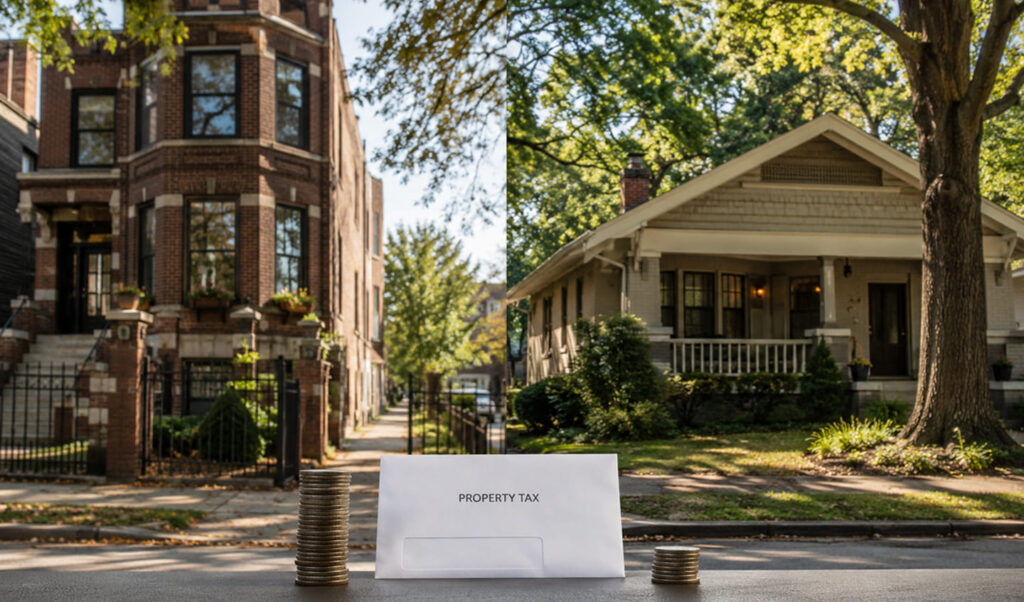
On a $400,000 loan, that year-over-year move adds about $193 a month in principal and interest: roughly $2,476 at 6.30% against $2,669 at 7.03% on a 30-year loan (our calculation). Property taxes come on top, and in Cook County they’re a large part of the monthly cost. How Cook County property taxes work walks through how that bill is built and why it jumps.
Rates change weekly. Get a current quote and a pre-approval before you shop instead of budgeting off a number from last month.
Chicago housing market predictions: what do the forecasts say?
Will Chicago home prices keep rising?
Forecasters expect a normal seasonal cool-down this fall and slower gains after that. DePaul’s September 2026 forecast projects single-family prices across the metro to ease about 4.4% between August and November, the usual autumn dip, and still finish November about 7.4% above November 2025. For the city, it projects single-family prices down almost 3% over the same stretch but still about 7.3% above a year earlier, and condo prices up about 2%, ending about 9.2% higher.
Sales are the softer part of the outlook, with metro sales from September through November expected to run about 7.5% below last year. Looking a year out, Zillow’s latest home value forecast, built on August 2026 data, calls for typical values in metro Chicago to rise about 3.1% by August 2027, more than double its 1.4% projection for the U.S. as a whole.
Forecasts can miss in either direction. When Illinois REALTORS announced DePaul’s 2026 forecast last December, the headline read, “Inventory is expected to continue growing modestly,” and the outlook called for metro sales to rise about 5.1% this year. By August, homes for sale across the metro were down 11.0% from a year earlier and sales were down 4.5%. The price call has held up better: the forecast expected metro prices to rise nearly 5%, and the August metro median was up 5.3%. Treat any forecast as an estimate that can move with rates and jobs.
Two things could slow the market faster than expected: rates holding above 7%, and a job market that’s softer here than nationally. DePaul notes Illinois unemployment was running 0.8 points above the national rate as of July.
What does this mean if you’re buying in Chicago?
In a market this competitive, most of the work that matters happens before the first showing. Four steps make the biggest difference:
1. Get fully pre-approved before you tour. With 43% of Cook County homes selling above asking, a seller weighing two offers will usually lean toward the one with verified financing.
2. Set your ceiling before a bidding situation starts. Work out the highest price at which the full monthly payment, including taxes and any condo assessment, still fits your budget, and hold to it.
3. Treat attorney review as a real step. Most Chicago-area purchase contracts include an attorney review period, usually five business days after both sides sign, when either side’s attorney can propose changes or cancel. The window is short, so line up an attorney before you write your first offer.
4. Compare supply town by town. If you have flexibility on location, check conditions in each place you’re considering. In DuPage County inventory is up 11.4% and fewer homes are going over asking than a year ago, while Lake County’s supply is still tightening.
Still deciding whether to buy at all? Renting vs. buying in Chicago works through the break-even math on how long you’d need to stay.
What does this mean if you’re selling in Chicago?
You’re selling into the fastest annual price growth among the 20 Case-Shiller metros, which makes one mistake tempting: pricing off the summer headlines. The city’s year-over-year gain slipped from 13.3% in July to 8.0% in August, and DePaul expects the usual fall dip through November, so a comparable sale that closed in July can overstate what a similar home brings in October. Price from recent closed sales near your address, adjusted for the season.
Presentation still matters in a seller’s market. Only 12.7% of active Cook County listings carried a price cut in August, per Redfin, so a home that sits while others sell is worth checking first on price against its recent comps.
One Illinois-specific detail catches sellers off guard: property taxes are paid a year in arrears here, so expect a tax proration credit to the buyer at closing. The Cook County tax guide explains how it works.
Selling in Chicago and buying in Florida or Georgia?
If you’re planning a move, the gap between markets is worth a look. Zillow’s latest forecast has metro Chicago values rising about 3.1% over the next year, against about 0.8% for both metro Atlanta and metro Jacksonville. That gap can mean selling where values are climbing faster and buying where they’re expected to rise more slowly, though forecasts aren’t guarantees and coordinating two closings in two states takes planning.
That coordination is the reason for the relocation hub. The step-by-step guides for moving from Chicago to Jacksonville and moving from Chicago to Atlanta cover the sequence, and the Jacksonville housing market 2026 update shows conditions on the Florida side.
Chicago housing market FAQs
Will the Chicago housing market crash?
Nothing in the current numbers suggests one. A crash typically needs a surge of homes for sale, often from forced selling, and Chicago has the opposite: the city had 23.3% fewer homes for sale in August 2026 than a year earlier, per Illinois REALTORS, and Chicago-area foreclosure activity remained below pre-pandemic levels, according to DePaul’s Institute for Housing Studies. DePaul expects metro single-family prices to ease about 4.4% from August to November, the usual seasonal dip, and still finish November about 7.4% above a year earlier.
There are softer spots. City single-family prices were up only about 2% in August, Evanston’s median was essentially unchanged from a year earlier over the summer, and DuPage County inventory rose 11.4%, per Redfin. Mortgage rates above 7% and an Illinois unemployment rate running above the national one are the main risks to watch. Slower price growth is a reasonable expectation for the coming year; a broad price decline would need conditions that aren’t showing up in the numbers now.
Are Chicago home prices going up or down right now?
Prices are up on an annual basis, with a seasonal dip expected this fall. The city’s median rose 8.0% to $405,000 in August 2026, per Illinois REALTORS, and Case-Shiller had the Chicago metro up 6.9% over the year to June. DePaul expects metro single-family prices to ease about 4.4% from August to November, as they typically do each autumn, while staying about 7% above last year’s level.
How fast are homes selling in Chicago?
Homes are selling quickly. City single-family homes spent 28 days on market in August 2026, and condos and townhomes 25 days, per DePaul. In Cook County, 43.2% of homes sold above asking in August, per Redfin, and only 12.7% of active listings carried a price cut.
What should Chicago buyers and sellers do before the year ends?
The fall slowdown gives both sides a little more breathing room than summer did, but it doesn’t change the underlying math: Chicagoland has too few homes for the buyers who want them. Buyers who arrive pre-approved with a firm budget tend to get more chances at the homes they want. Sellers who price from recent sales near their address tend to spend less time on market and see fewer price cuts.
Curious how your street compares with these numbers? Email Nia at listwithnia@gmail.com and you’ll get recent closed sales near your address plus a monthly cost estimate that includes your local property tax bill, whether you’re buying or getting ready to list. As a Realtor licensed in Illinois, Florida, and Georgia with LPT Realty, Nia is glad to talk through your timing, including a move south, with no pressure to commit to anything.