
What’s the Jacksonville housing market like in 2026?
Duval County homes sold at a median of $345,000 in September 2026 and took 29 days to sell, with a 3.8-month supply, according to the Northeast Florida Association of REALTORS® (September report, via News4JAX). Prices are a little higher than a year ago, but homes are selling more slowly than in early summer and 30-year mortgage rates hit 7.40% in early October, so buyers have more room to negotiate than they did in June.
That’s the short version. Below is what the numbers say, and what they mean whether you’re buying or selling on the First Coast this fall.
What’s happening with Jacksonville home prices?
Prices are slightly up over the year and below their early-summer level. The median price of a single-family home in Duval County was $345,000 in September 2026, per NEFAR, up from $335,000 in August. A year earlier, NEFAR’s September 2025 figures put the Duval median at $330,000, as reported by the Jacksonville Daily Record, so the annual gain is about 4.5% by our calculation.
Across the wider six-county region, which covers Duval, Clay, St. Johns, Putnam, Nassau, and Baker, the median was $399,000, up 1.1% from August. That’s down from $420,000 in June. A monthly median moves with the mix of homes that happen to close, so a summer-to-fall drop tells you more about which homes sold than about what any one home is worth. The annual comparison is the steadier read.
One caution on figures you’ll see elsewhere: portal estimates for “Jacksonville” often measure the city limits or a different mix of property types, so they can land well below the county number. The figures here come from NEFAR’s MLS data throughout.
Is it a buyer’s or seller’s market in Jacksonville?
So who has the upper hand right now?
Neither side has it outright. Supply still sits under the roughly six months that marks a balanced market, so sellers keep some advantage, but it has grown since June and homes are taking longer to sell. NEFAR President Kim Knapp put it this way in the September release: “Buyers have more choices and negotiating power, while sellers are learning that yesterday’s pricing strategies may not work in today’s market.”
Here’s the snapshot:
| Metric | Duval County | Six-county region |
|---|---|---|
| Median sale price, September 2026 | $345,000 | $399,000 |
| Median sale price, June 2026 | $350,000 | $420,000 |
| Median days on market, September 2026 | 29 days | 36 days |
| Median days on market, June 2026 | 25 days | 31 days |
| Active listings, September 2026 | 3,139 | 6,287 |
| Months of supply, September 2026 | 3.8 | 4.0 |
| Months of supply, June 2026 | 3.5 | 3.4 |
All figures are single-family homes from NEFAR’s monthly releases. NEFAR reports county changes month over month, so the June rows come from the association’s June 2026 release rather than from a published change figure.
Two numbers carry most of the meaning. Duval’s median time to sell went from 25 days in June to 29 in September, and its supply went from 3.5 months to 3.8. The count of active listings actually fell over the same stretch, from 3,481 to 3,139. Supply measured in months rose anyway because buyers bought more slowly: Duval recorded 830 closed sales in September, down 9.1% from August. Buyers are taking longer to decide, while the number of homes for sale has shrunk.
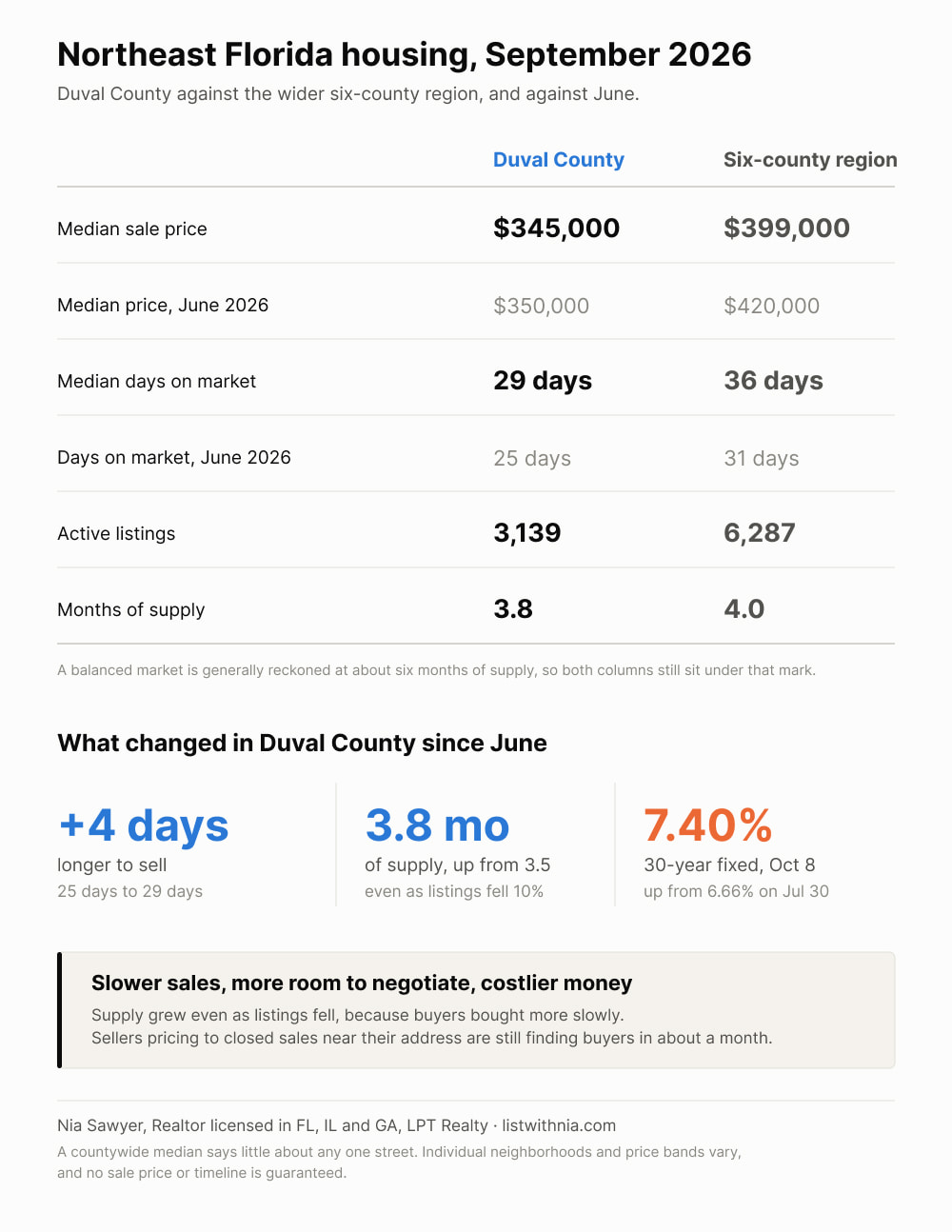 Source: Northeast Florida Association of REALTORS, September 2026 release (published October 8, 2026), compared against its June 2026 release. Single-family homes. The six-county region is Duval, Clay, St. Johns, Putnam, Nassau and Baker, so the regional median runs above Duval’s. NEFAR reports county changes month over month; the June figures come from the June release itself. Mortgage rate: Freddie Mac PMMS, 30-year fixed, week of October 8, 2026.
Where mortgage rates sit, and why it matters
Rates have done more to change this market since summer than prices have. The 30-year fixed averaged 7.40% for the week of October 8, 2026, up from 7.28% the week before and 6.30% a year earlier, per Freddie Mac’s Primary Mortgage Market Survey. That’s the highest weekly reading since November 2023, and up from 6.66% at the end of July. The 15-year averaged 6.73%.
Here’s what that does to a payment. On a $310,500 loan, which is the Duval median of $345,000 with 10% down, principal and interest come to about $2,150 a month at 7.40%, against about $1,922 at last year’s 6.30%. That’s roughly $228 more every month on the same loan, before taxes, insurance, or mortgage insurance (our calculation).
Rates move week to week. Get a current quote and a pre-approval before you shop rather than budgeting off a number you read last month.
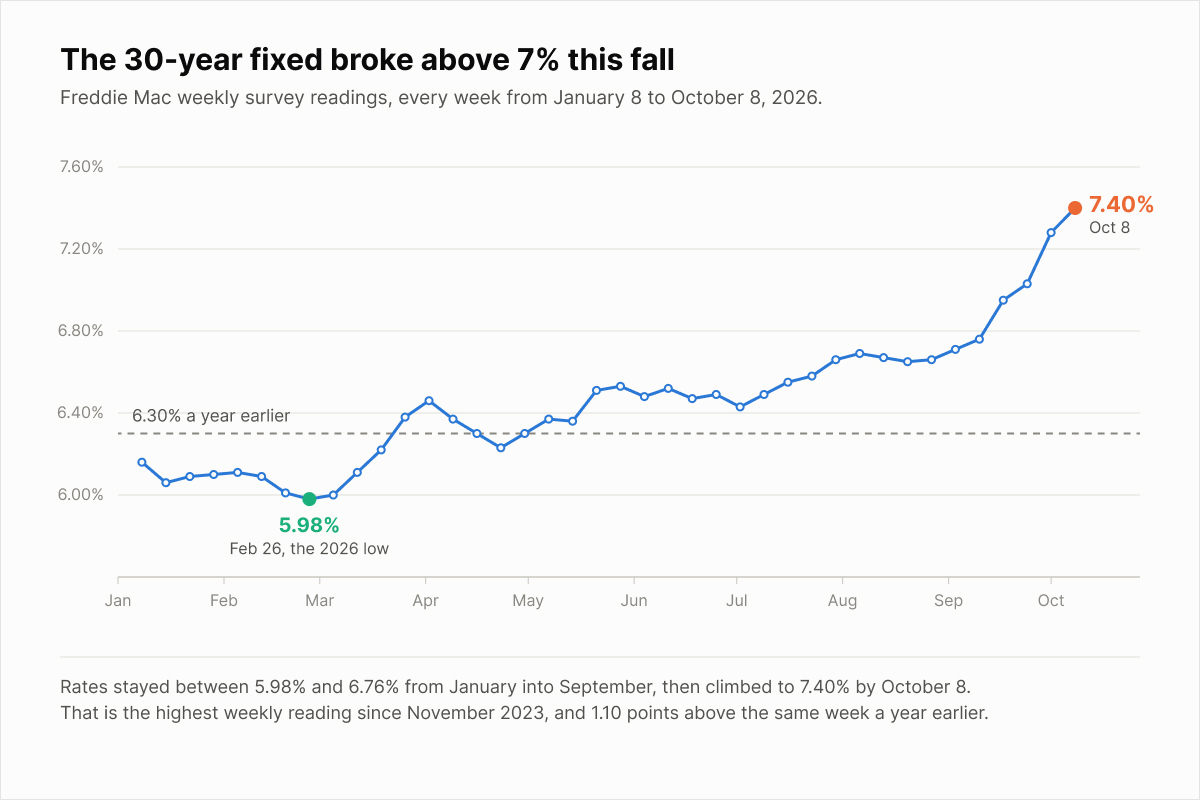 Source: Freddie Mac Primary Mortgage Market Survey, 30-year fixed-rate average. Each dot is one weekly survey reading. Rates are national averages for borrowers with strong credit and 20% down, and move weekly. listwithnia.com
What this means if you’re buying in Jacksonville
You have more room than a buyer had in June, and a higher rate than a buyer had a year ago. Your strategy lives in the gap between those two facts.
➤ Negotiate where the listing has aged. With the Duval median at 29 days, a home sitting past 60 days is a different conversation from one listed last week.
➤ Ask what the seller will put toward your costs. When homes sit longer, some sellers would rather contribute to closing costs or a rate buydown than cut the price. Whether one agrees depends on the home and your offer. Jacksonville closing costs shows what those credits can cover.
➤ Budget for the full monthly cost, not just the price. Florida insurance is the line that surprises newcomers most, and I explain what drives a quote in Jacksonville home insurance costs. Newer communities can add CDD fees, and property taxes could shift if voters approve Amendment 3 on the November 3 ballot.
➤ Buying for the first time? The first-time home buyer steps for Jacksonville cover pre-approval and the local down payment assistance programs in order.
Moving in from out of state? Map those carrying costs before you tour. See how a coordinated move works.
What this means if you’re selling in Jacksonville
A slower month tempts sellers into one of two errors: pricing off the spring headlines, or cutting too far too fast. Price off closed sales near your address instead. The regional median of $399,000 includes St. Johns County, where the median is $568,750, so it says little about a typical Duval house. Your comps are the ones within about half a mile of your door.
Knapp’s second point in the release is the useful one for sellers: “homes that offer the right combination of price, condition and value are better positioned to attract attention.” Accurate pricing, strong photography, and paperwork handled up front still sell homes in about a month.
Timing matters less than many sellers expect. I walk through the seasonal data and the Jacksonville factors that do move it, from hurricane-season insurance binding to military moves, in the best time to sell a house in Jacksonville. If your home is listed and not moving, the cause is usually price, condition, or exposure, and I cover the specific traps in 7 costly mistakes Jacksonville home sellers make.
Nearby markets move differently
The First Coast isn’t one market, and September shows the spread clearly. In the same NEFAR release, the median single-family price was $345,000 in Duval County (29 days on market), $355,000 in Clay County (48 days), and $568,750 in St. Johns County (42 days). Nassau County’s median was $496,500, with a 4.5-month supply.
Those gaps reflect different housing stock, lot sizes, and the age of the communities involved, and they come with different property tax rates and CDD exposure. Buyers comparing St. Augustine and Ponte Vedra (St. Johns), Orange Park and Fleming Island (Clay), and Fernandina Beach (Nassau) are really comparing different cost structures, which is why the county figure matters more than the metro average.
Jacksonville housing market FAQs
Is 2026 a good time to buy in Jacksonville?
That depends on your budget and timeline more than on the calendar. Duval County carried a 3.8-month supply in September 2026, up from 3.5 months in June, and homes sold in a median of 29 days, per NEFAR, so buyers have more time to decide than they did in early summer. The trade-off is cost: the 30-year fixed averaged 7.40% in early October, per Freddie Mac, against 6.30% a year earlier, which adds roughly $228 a month in principal and interest on a $310,500 loan.
Buyers with a current pre-approval and a full monthly budget, including Florida insurance and property taxes, are better placed to use the extra negotiating room. The right answer depends on the specific home and what it costs you to own it each month, not on the headline.
Are Jacksonville home prices going up or down in 2026?
Slightly up over the year, and below the early-summer level. Duval County’s median single-family price was $345,000 in September 2026, per NEFAR, against $330,000 in September 2025, about 4.5% higher by our calculation. In June the Duval median was $350,000 and the six-county median was $420,000; by September the region stood at $399,000.
Monthly medians move with the mix of homes that close, so the annual comparison is the steadier read. Individual neighborhoods and price bands vary, and a countywide median tells you little about a specific street.
How long does it take to sell a home in Jacksonville right now?
A median of 29 days in Duval County in September 2026, per NEFAR, up from 25 days in both June and August. The six-county figure runs longer at 36 days, and Clay County homes took a median of 48 days. Median means half of all homes took longer, and pricing, condition, and photography account for much of the spread.
Should you buy or sell in Jacksonville this year?
The fall 2026 market rewards preparation over timing. Buyers who are financially ready can negotiate on homes that have sat, and sellers who price to current closed sales rather than to spring headlines are still finding buyers in about a month. Either way, run your real numbers first: the payment at today’s rate, taxes, insurance, and any CDD or association fees.
Want to see where your address sits inside these numbers? Email Nia at listwithnia@gmail.com and you’ll get current comparable sales for your neighborhood alongside the monthly carrying cost, whether you’re buying or listing.
As a Realtor licensed in Florida, Illinois, and Georgia with LPT Realty, Nia works the Jacksonville market month to month and is glad to talk it through before you commit to anything.