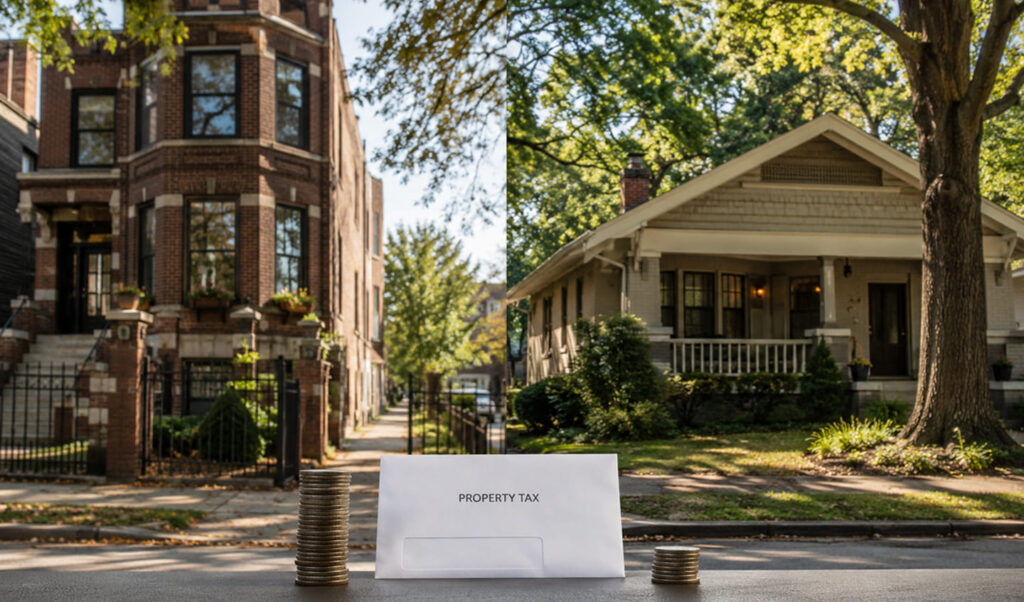
How do Cook County property taxes work, and why did my bill jump?
Cook County property taxes run through four steps: your home is assessed at 10% of its fair market value, that number is multiplied by a state equalization factor, your exemptions come off, and your local composite tax rate is applied to what is left. Bills usually jump for one of two reasons, and they are easy to tell apart: either your township hit its every third year reassessment, or the taxing districts around you asked for more money.
If you own in Chicago, Evanston, Berwyn, or Orland Park, this is the year to understand the difference. The tax year 2025 bills are arriving now, later than usual, and many are higher than last year.
Table of Contents
When your bill arrives this year, and why it is late
Cook County announced on August 18, 2026 that roughly 1.8 million second installment bills would be mailed September 1 and are due October 1, according to the Cook County Board President’s office. That is about two months past the usual August 1 deadline, which the county attributes to a “cascade effect” from its property tax technology overhaul.
One quirk to note first: Illinois taxes property a year in arrears. The bill landing in your mailbox in September 2026 is the tax year 2025 bill. That drives how proration works at an Illinois closing, and it is the most common surprise for buyers arriving from states that bill for the current year.
The four-step math behind the number
Here is the calculation the Cook County Assessor’s Office runs, using a $350,000 suburban Cook home as an example:
1. Fair market value: $350,000. This is the Assessor’s estimate, not your listing price.
2. Assessed value at 10%: $35,000. Residential property in Cook County is assessed at 10% of market value.
3. Equalized Assessed Value: $106,050. The Illinois Department of Revenue set the final 2025 Cook County equalization factor at 3.0300, announced June 18, 2026. It is applied to bring county assessments in line with a statewide benchmark.
4. Less exemptions, times your composite rate: subtract the $10,000 Homeowner Exemption to reach $96,050, then apply your local composite rate. At roughly 7% that is about $6,700 a year.
Treat that last line as illustrative. Composite rates are set by the Cook County Clerk and vary widely, running lower in parts of the north suburbs and considerably higher in parts of the south suburbs. Two identical houses on the same assessed value can carry very different bills depending on which districts serve them.
Notice what is missing: nobody sets your bill directly. It emerges from all four inputs at once, which is why a jump can come from any of them.
Reason one your bill jumped: it was your township’s turn
This one runs on a schedule you can look up.
The Assessor reassesses one third of Cook County every year, in three groups called triads. The City of Chicago was reassessed in 2024 and comes up again in 2027. The north and northwest suburbs were reassessed in 2025. The south and west suburbs are being reassessed in 2026, their first since 2023, with township values released through the spring and summer: Berwyn in May, Palos in early June, Cicero in mid June, along with Proviso, Riverside, River Forest, and Worth.
What that cycle does to bills is visible in this year’s numbers. The Cook County Treasurer’s annual analysis, released August 24, 2026, found that median home bills in the north suburbs rose 6.7% while median business bills there rose 0.1%. The north suburbs were the triad reassessed for 2025. Chicago homes, a year past their reassessment, rose 3.2%.
Individual swings ran sharper than the median suggests. The Chicago Sun-Times reported a median increase near 21% in Prospect Heights, a northwest suburb in the reassessed triad. The cycle cuts the other way too: in the south suburbs, University Park saw a median decrease of nearly 30%.
So if you own in Oak Park, Cicero, Palos Heights, or Tinley Park, your 2026 reassessment notice has already been mailed, and it will shape the bill you receive in 2027. That is your window to act, not next fall.
Reason two: the districts around you asked for more
Reassessment redistributes the burden. It does not create it. The total comes from levies, and those went up again.
Taxing agencies billed $19.9 billion across Cook County for tax year 2025, seeking $743.8 million in new taxes, per the Treasurer’s analysis. That is a 3.9% increase against 3.1% regional inflation, and the 32nd consecutive year of increases. Homeowners absorbed about 80% of the new money.
Illinois limits some of this. Under the state’s Property Tax Extension Limitation Law, increases in a non home rule district’s extensions are held to “the lesser of 5 percent or the increase in the consumer price index for the year preceding the levy year.”
That is narrower than most homeowners assume. The Department of Revenue’s technical manual states plainly that “the PTELL does not ‘cap’ individual property tax bills,” and lists why yours can still outrun inflation: a district on your bill is home rule and exempt, such as the City of Chicago or Cook County itself; a district issued new bonds; or voters approved an increase through one of the referendum options PTELL allows. That last one is why a park or school district referendum can move your bill more than a reassessment did.
Four quieter reasons a bill jumps
These catch people off guard because nothing about the house changed.
➤ An exemption fell off. The Homeowner Exemption reduces your Equalized Assessed Value by $10,000, and it does not automatically follow a change in the names on the deed. A refinance into a trust, an inheritance, a divorce, or a purchase can interrupt it. This is the most common cause of a bill that jumps for no visible reason.
➤ A senior benefit lapsed. The Senior Exemption takes another $8,000 off EAV, and the Low-Income Senior Freeze holds EAV steady for qualifying households. The Freeze carries an income test that must be met each year, with the threshold moving from $65,000 for tax year 2025 to $75,000 for 2026.
➤ You skipped an appeal you used to file. Appeal relief applies to a single assessment year. Win one, do nothing the next cycle, and the reduction does not carry forward on its own.
➤ Commercial values shifted the load. When commercial assessments are reduced on appeal, the levy does not shrink. It redistributes onto everything else in the district, including homes.
How suburban Cook compares to the collar counties
Buyers weighing Naperville in DuPage County, Libertyville in Lake County, or Joliet in Will County notice something confusing: those counties assess near the statutory 33 1/3% of market value and carry equalization factors at or close to 1.0000, while Cook assesses at 10% and applies a factor above 3. Read nothing into that on its own, since Cook’s 10% times 3.0300 lands near 30% of value anyway.
The number that matters is the effective rate, meaning annual tax divided by market value, and it varies more between two Cook townships than it often does between Cook and DuPage. Compare addresses, not counties.
How to read your notice and appeal it
Your Notice of Assessment and your tax bill are different documents arriving at different times. The notice is where you have leverage. By the time the bill arrives, the assessment window has closed.
The appeal path has three stages:
1. Cook County Assessor. Each township opens on a rolling schedule with a filing window of roughly 30 days. This stage is optional, and decisions typically take two to four months.
2. Cook County Board of Review. Opens after the Assessor closes that township, again with about a 30 day window. This is a separate body with its own evidence standard, and you can file here even if you skipped the Assessor.
3. Illinois Property Tax Appeal Board. A petition must be filed within 30 days of the Board of Review’s written decision, per the Illinois Property Tax Appeal Board. That deadline is statutory and cannot be extended.
The strongest evidence is usually recent sales of comparable homes in your township, or a factual error in the record such as wrong square footage. First, confirm every exemption you qualify for is applied, since a missing one is fixed with a form, not an appeal.
If you are buying in Cook County this year
Three things worth doing before you close:
➤ Do not budget from the seller’s current bill. Their exemptions do not transfer to you. A long-time senior owner’s bill can understate what you will pay by thousands.
➤ Check the township’s place in the cycle. Buying in a south or west suburb in 2026 means the reassessment already happened and the resulting bill has not arrived yet.
➤ Check your proration. Closing credits cover a tax year that has not been billed. Ask your attorney how the credit was calculated and what happens if the real bill exceeds it.
Cook County property taxes FAQs
Why did my Cook County property tax bill go up when my home’s value did not change?
Most often because a taxing district raised its levy, or because assessments elsewhere in your district fell and shifted the burden onto you. A lost exemption is the third common cause.
When are Cook County property taxes due in 2026?
The tax year 2025 second installment was mailed September 1, 2026 and is due October 1, 2026, roughly two months later than the customary August 1 date.
How much is the Cook County Homeowner Exemption worth?
It removes $10,000 from your Equalized Assessed Value, not $10,000 from your bill. The actual savings depend on your composite rate.
Does appealing my assessment lower my tax bill?
It can, but not by a guaranteed amount. An appeal lowers your assessed value, while your bill also depends on your district’s levy and rate. In a year of rising levies, a win may hold your bill flat rather than reduce it.
Which Cook County townships are being reassessed in 2026?
The south and west suburban triad, including Berwyn, Cicero, Palos, Riverside, River Forest, and Worth townships. Those values drive bills payable in 2027.
What to do with the bill in your hand
Open the notice before the bill, and confirm your exemptions are listed. Then work out whether your increase came from a reassessment, which you can appeal, or a levy, which you cannot. Most homeowners never separate the two.
Not sure which one moved your number? Email Nia at listwithnia@gmail.com and you will get a plain-English read of your notice alongside recent comparable sales in your township. As a Realtor licensed in Illinois, Florida, and Georgia with LPT Realty, Nia works with Chicago and suburban Cook owners on what these numbers mean for buying, selling, or simply staying put, with no pressure either way.
Related reading: Renting vs. buying in Chicago walks through how a tax bill fits into a monthly payment, and the Chicago real estate guide covers the wider market. Planning a move out of state? See moving from Chicago to Atlanta or moving from Chicago to Jacksonville.