How long should you rent before buying in Chicago?
Rent until you can commit to staying in the same home for about five years and you’ve saved your down payment plus a cash reserve, which for many Chicago renters works out to one to three years. Renting also costs far less month to month here right now, so your time horizon, not the monthly payment, usually settles renting vs. buying in Chicago.
Why “how long” is the real Chicago question
Most renters frame the choice as rent or buy. The sharper question is how long you’ll stay, because that single number decides whether buying pays off. Buy a Chicago condo, get relocated for work eighteen months later, and the cost of selling can wipe out any gain you built. Rent for a decade in a market that keeps appreciating, and you miss years of equity and a fixed payment.
Chicago makes the timing question sharper than most metros for two reasons. Cook County carries some of the highest property taxes in the country, so owning costs more to hold each year. And while prices jumped over the past year, forecasters expect gains to slow from here, and the city’s long-run appreciation has trailed the national average, so one strong year is no promise for the next five. Both push the break-even point later.
In closings I’ve handled for renters becoming first-time buyers, the ones who waited until their timeline was clear almost never regretted the extra months of renting. The good news is that this is a math problem, and the numbers below make the trade-off clear.
What does it cost to rent vs. buy in Chicago right now?
Renting costs less month to month today; buying costs more up front and monthly but builds equity and locks your payment. The typical Chicago rent was about $2,340 a month in August 2026, up about 5.8% from a year earlier, according to the Zillow Observed Rent Index. Studios and one-bedrooms rent for less and larger units for more, so price the size you actually need.
On the buying side, the city’s median sale price was $405,000 in August 2026, up 8.0% from a year earlier, according to Illinois REALTORS. The average 30-year fixed mortgage rate was 7.40%, according to Freddie Mac (week of October 8, 2026).
On a $405,000 home with 10% down, your principal and interest come to about $2,525 a month before taxes, insurance, and upkeep. Here’s how the two paths compare for a typical Chicago move:
| Factor | Renting a typical home | Buying a $405,000 home (10% down) |
|---|---|---|
| Upfront cash | First month + security deposit, roughly $4,000–$5,000 | Down payment + closing costs, roughly $49,000–$53,000 |
| Rough monthly housing cost | ~$2,340 (Zillow, August 2026) | ~$3,700–$4,100 all-in (P&I at 7.40% + taxes + insurance + upkeep + PMI) |
| Payment stability | Resets at each lease renewal | Principal and interest fixed for 30 years |
| Builds equity | No | Yes, over time |
| Who handles repairs | The landlord | You |
| Flexibility to move | High | Lower; selling runs about 7–9% of price |
Two Chicago line items widen that monthly gap, so build them into your budget from the start:
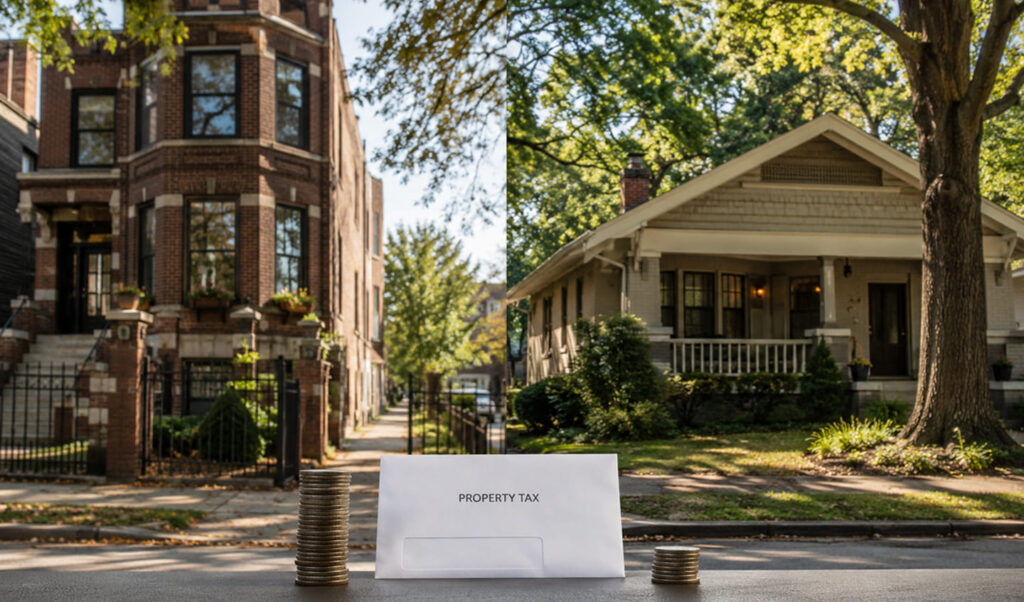
1. Property taxes. Cook County’s effective rate runs high. Chicago sits around 1.8% to 2.0% of value, and many suburbs run higher, per the Cook County property tax overview (SmartAsset, 2026). On a $405,000 home that’s roughly $7,300 to $8,100 a year, or about $640 a month, added to your payment. The City of Chicago’s next reassessment comes in 2027, and how Cook County property taxes work explains how the bill is built and why it can jump.
2. Homeowners insurance. Illinois premiums have climbed with severe-weather claims. The state average is about $2,600 a year for $300,000 in dwelling coverage, according to Insure.com (2026), with Chicago-area homes often landing in the $2,300 to $2,800 range.
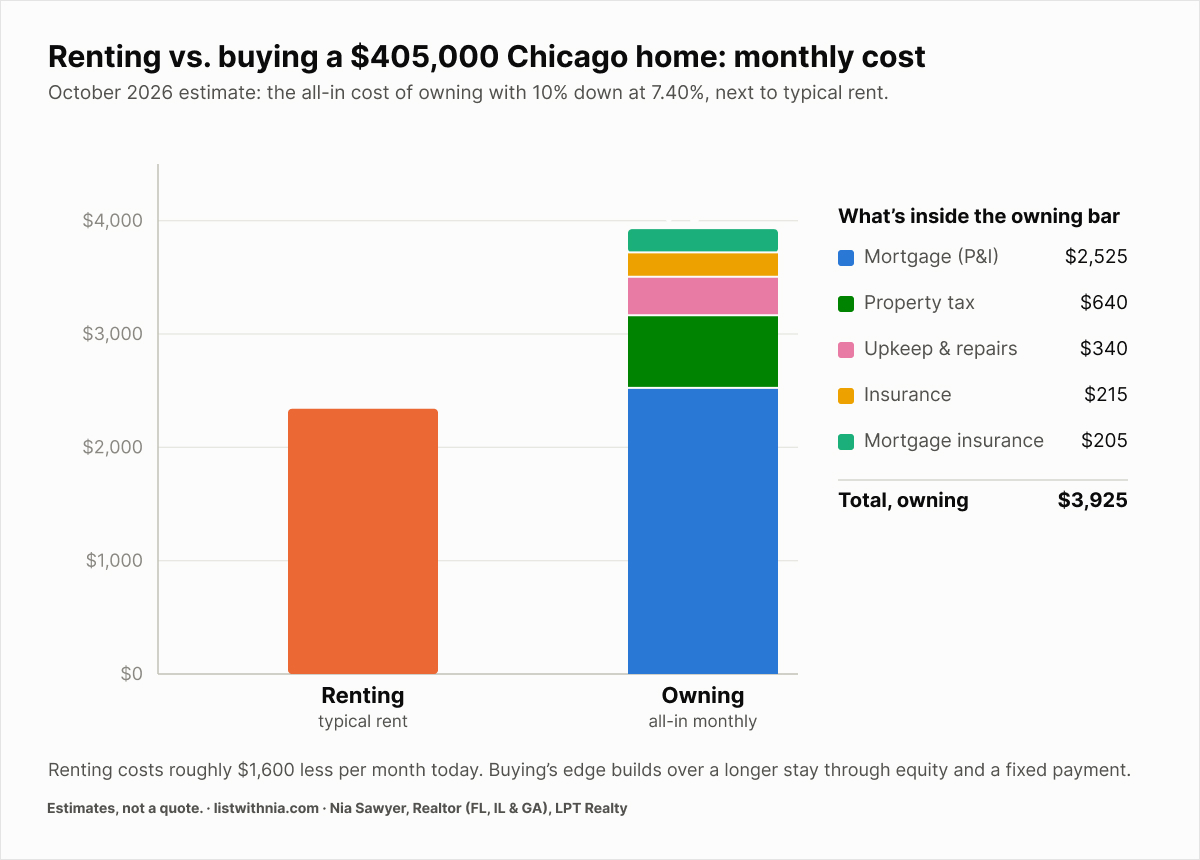
Sources: Zillow Observed Rent Index (Aug 2026); Illinois REALTORS city median $405,000 (Aug 2026); Freddie Mac 30-yr fixed 7.40% (Oct 8, 2026); property tax at ~1.9% of value (SmartAsset, Cook County); insurance, Insure.com.
What’s the break-even point on buying in Chicago?
Break-even is the point where the equity you’ve built covers what you spent to buy and sell, and in Chicago that usually takes about five years, sometimes longer. Buying costs 2% to 3% of the price in closing costs, and selling costs another 7% to 9% once you add agent commissions, attorney fees, and Illinois, Cook County, and City of Chicago transfer taxes. Appreciation and loan paydown have to grow past that round trip before you come out ahead.
Don’t build your plan on the past year repeating. Chicago led all 20 metros in the S&P Cotality Case-Shiller index with a 6.9% annual gain in June 2026, but Zillow’s forecast built on August 2026 data calls for metro values to rise about 3.1% over the following year, and over the long run the city’s appreciation has trailed the national average, per Zillow home-value data.
I walk through the forecasts in the Chicago housing market 2026 update. At a few percent a year, appreciation still needs several years just to cover the cost of selling, and the high annual property-tax bill adds to your holding cost the whole time.
That math is why I tell Chicago renters to look at their stay horizon first. If you’re confident you’ll keep the same home past the five-year mark, buying tends to reward the wait. If your next few years are uncertain, renting a while longer is a reasonable financial call, not a failure to launch.
This is professional insight, not a promise, so run your own numbers with a lender before you decide.
When does renting longer make more sense?
Renting is usually the stronger move when your plans, your cash, or your neighborhood are still up in the air. It keeps you flexible while you learn the market and save.
Rent longer if several of these fit you:
1. You might move within five years. A likely job change, a change in the space you need, or an out-of-state move on the horizon all favor renting, since a short stay rarely clears Chicago’s buying and selling costs.
2. Your down payment and reserves aren’t there yet. Buying while cash-thin leaves nothing for the property-tax escrow shortfall or the first big repair on an older Chicago building.
3. You haven’t settled on an area. Chicago’s neighborhoods and the nearby suburbs in Cook, DuPage, Lake, and Will counties differ a lot on price, taxes, and commute. A lease lets you test your actual commute before you commit six figures.
4. Your income is new or variable. Lenders reward a steady work history, and so does your own budget in the first year at a new job.
5. You want to watch rates. With the 30-year fixed above 7% this fall, some renters wait a year for a better financing window rather than locking in under pressure.
Renting isn’t wasted money. You’re paying for flexibility and for time to make a large decision well.
When are you ready to buy in Chicago?
Buying tends to win once you’re staying put and your finances are steady, because a fixed mortgage stops your housing payment from climbing at every lease renewal while you build equity. Chicago stays a tight, seller-favored market, so being ready to move matters.
Cook County had about 3 months of supply in August 2026, against roughly 4 nationally, per Redfin, and the city had 23.3% fewer homes for sale than a year earlier, per Illinois REALTORS. City single-family homes sold in a median of 28 days and condos and townhomes in 25, per DePaul’s Institute for Housing Studies. When you’re financially ready, plan to act quickly, because well-priced homes still move fast.
You’re often ready to buy when:
✓ You’ll stay five years or more. That’s typically enough time for appreciation and paydown to clear your buying and selling costs, though it’s a guideline, not a guarantee.
✓ You have stable income and a real down payment, plus a cushion for Cook County taxes and maintenance on an older home.
✓ You want to lock your housing cost. A fixed payment is a hedge against future rent increases, which ran about 5.8% year over year in Chicago in August 2026, per Zillow’s rent index.
✓ You’ve picked your area. You know your commute, your ward or suburb, and the trade-offs between, say, a condo near the Loop and a single-family home on the Northwest Side or in the western suburbs.
One caution I give every renter: don’t let “rates are high” alone talk you out of a home you’ll keep for a decade. If rates fall, you can often refinance later, though refinancing has its own costs and there’s no promise rates will drop.
What you can’t do is go back and buy at today’s price if values rise. Run the numbers for your own situation.
How long should you rent? Work through five questions
Answer these in order, and the timeline usually settles itself:
1. How long will you stay? Under three years leans rent; five or more leans buy. The in-between is a judgment call.
2. Is your cash ready? Add up the down payment, closing costs, and a reserve for taxes and repairs. If it’s tight, keep renting and keep saving.
3. Do you know your area? If not, rent in the general area and narrow it down on the ground before you buy.
4. Is your income stable? A steady paycheck strengthens both your loan terms and your budget.
5. Does the all-in monthly cost fit? Compare a real rent quote against a real ownership estimate with Cook County taxes and insurance included, not principal and interest alone.
If you’re weighing Chicago against a move south, the same framework applies in warmer markets. I walk through it for Florida in renting vs. buying in Jacksonville.
Renting vs. buying in Chicago: FAQs
Is it cheaper to rent or buy in Chicago in 2026?
Month to month, renting is cheaper today: typical rent is about $2,340, while all-in ownership on a $405,000 home runs closer to $3,700 to $4,100 with taxes, insurance, upkeep, and PMI at October 2026 rates. Buying tends to pay off over a longer stay through equity and a fixed payment.
How long should I rent before buying in Chicago?
Plan to rent until you can commit to staying about five years and you’ve saved your down payment plus a reserve, which is often one to three years. That horizon usually clears Chicago’s high buying and selling costs.
How much do I need to buy a $400,000 home in Chicago?
Plan for roughly $49,000 to $53,000 with 10% down plus closing costs, and keep a separate cushion for Cook County property taxes and early repairs.
Do Chicago property taxes change the rent-vs-buy math?
Yes, by a lot. Cook County’s effective rate near 1.8% to 2.0% can add about $640 a month to ownership on a $405,000 home, so compare the all-in cost, not the mortgage payment alone.
What’s the right next step for your timeline?
Still unsure whether you’re a year away from buying or ready now? The smartest first move is to price out both paths with real Chicago numbers and match them to your stay horizon before you commit.
Bring your target neighborhoods, your budget, and your likely timeline, and we’ll build a side-by-side rent-versus-buy comparison for your situation across the city and nearby Cook, DuPage, and Lake counties.
Ready to run your numbers? Email Nia at listwithnia@gmail.com and you’ll get a rent-versus-buy breakdown built on current Chicago figures. As a Realtor licensed in Florida, Illinois, and Georgia with LPT Realty, Nia helps renters decide on a timeline that fits their plans, not a sales pitch.