What does home insurance cost in Jacksonville, and why does the roof matter so much?
Jacksonville home insurance generally runs below Florida’s statewide average, because Duval County sits farther from the coast and carries lower hurricane exposure than South and Southwest Florida. But the biggest factor in your specific quote usually is not the price of the house. It is the age and condition of the roof.
That surprises almost everyone moving here. You can look at two houses on the same street, same size, same price, and get quotes that differ by thousands of dollars a year. The difference is rarely the house. It is the paperwork attached to it.
Where Jacksonville actually sits in the Florida picture
Florida is the hardest homeowners insurance market in the country, and buyers arriving from Illinois or Georgia are usually working from a number that has no bearing here. The good news is that Northeast Florida is not South Florida. Duval County’s distance from the coast and comparatively lower hurricane exposure mean local premiums generally land below the statewide average.
The market has also stopped getting worse. Citizens Property Insurance, the state-backed insurer of last resort, cut rates for 2026, with homeowners multiperil policyholders seeing an average 8.8% reduction and wind-only policyholders an average 5.5% reduction. The new rates took effect July 1, 2026 for new policies and apply to existing ones at renewal. It is Citizens’ first personal-lines decrease since 2015, and the Office of Insurance Regulation actually set the reduction larger than Citizens itself had requested.
Read that as direction of travel rather than as your renewal notice. Citizens is the insurer of last resort, its book is concentrated in South Florida, and its largest cuts landed in Broward and Miami-Dade. Most Duval buyers end up with a private carrier. It tells you the market has stabilized enough for rates to move down, not that any particular house will be cheaper to insure.
The real problem: the quote arrives too late to be useful
Here is how it usually goes wrong, and I see it often enough that it is worth spelling out.
A buyer finds a house, writes an offer, gets it accepted, and starts the inspection period. Somewhere around day seven, once the home inspection is back, someone finally calls an insurance agent. That is when they learn the roof is 22 years old, that two carriers have declined it outright, and that the one quote they can get is far above what they budgeted.
By then they have already paid for an inspection and often an appraisal, and the negotiating leverage is mostly spent: the seller has been off the market for a week and the buyer is committed to the house.
The fix is not complicated. It is a sequencing change: settle the Jacksonville home insurance question before you write the offer, not after. Everything below is what makes that possible.
What actually drives your Jacksonville home insurance quote
In rough order of how much they move the quote:
➤ Roof age and condition. The dominant factor, ahead of everything else.
➤ Roof covering and shape. A hip roof sheds wind better than a gable, and carriers price that.
➤ Year built. Homes built to the post-2002 Florida Building Code price differently than older stock in Riverside, Springfield, or Murray Hill.
➤ Distance to the coast. A house in Jacksonville Beach, Atlantic Beach, or Neptune Beach carries wind exposure that a comparable home in Mandarin, Arlington, or out toward the Westside does not. The same gradient runs south into Clay County.
➤ The property’s claim history, not just yours. Prior water or roof claims attached to the address follow it.
➤ Electrical, plumbing, and HVAC on older homes, which is where the four-point inspection comes in.
One Florida-specific item catches nearly every out-of-state buyer: your hurricane deductible is separate from your regular deductible, and it is a percentage of your dwelling coverage rather than a flat dollar figure.
It is commonly offered at 2%, 5%, or 10%. On a home insured for $350,000, choosing 2% versus 5% is the difference between a $7,000 and a $17,500 deductible if a named storm hits. That choice moves your premium substantially, and it is worth understanding before you pick the cheapest quote on the page.
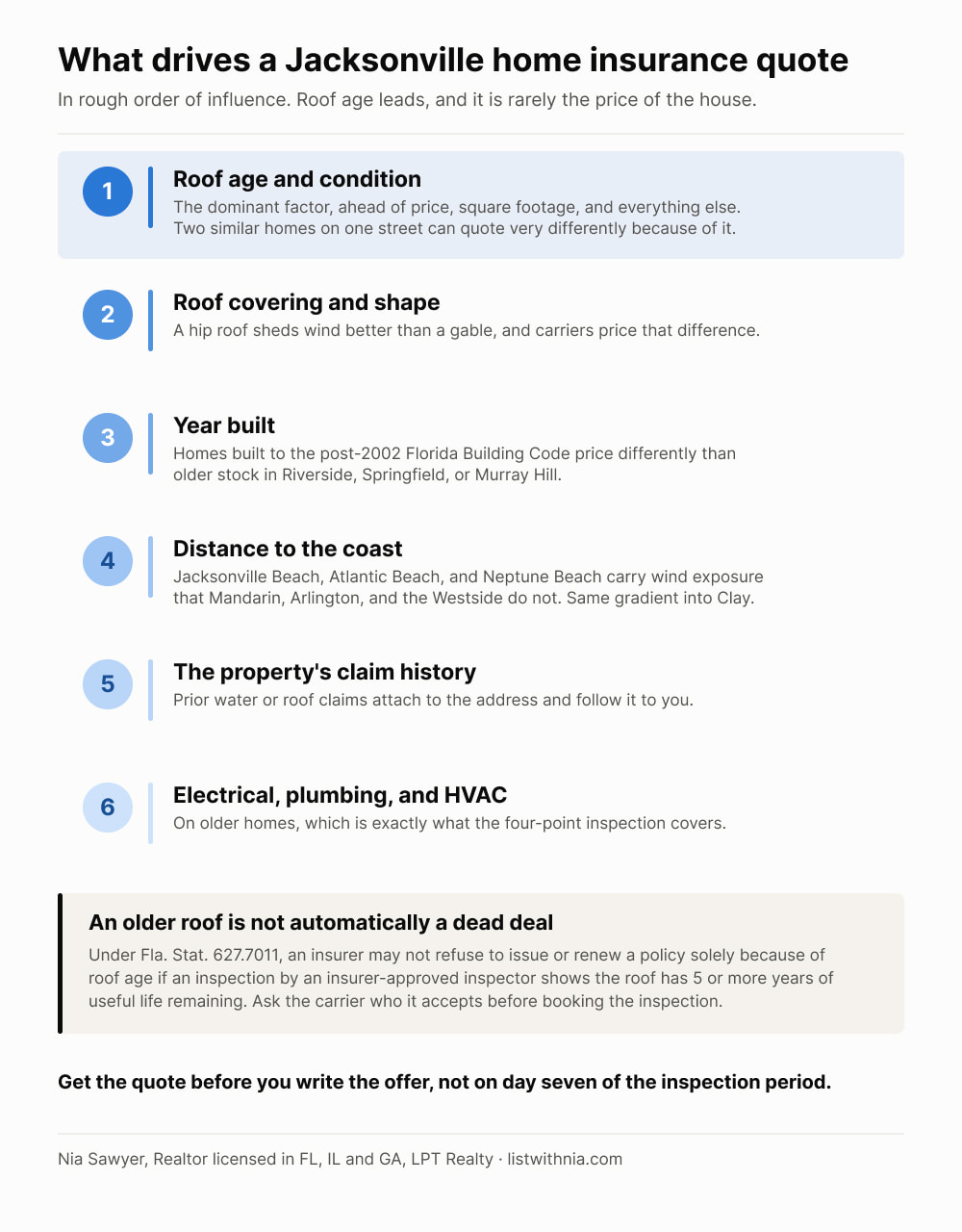 Ordering reflects typical Florida underwriting emphasis, not a measured scale. Every property differs and no premium is implied. Nia is a Realtor, not a licensed insurance agent. Quotes and coverage decisions come from a licensed Florida agent and the carrier.
The Florida roof rule most buyers have never heard of
This is the part that changes outcomes, and most people never learn it.
Under Fla. Stat. 627.7011, an insurer may not refuse to issue or refuse to renew a policy solely because a roof is less than 15 years old. For a roof that is 15 years or older, the insurer must allow you to have an inspection done by an authorized inspector, at your expense, before it can require a full roof replacement as a condition of writing or renewing the policy. If that inspection shows the roof has five years or more of useful life remaining, the insurer may not refuse solely because of the roof’s age.
Read that again, because it is worth real money. A 17-year-old roof in good condition is not automatically a dead deal. It is an inspection away from being insurable, at a small fraction of the cost of a roof.
One detail that trips people up: the statute defines an authorized inspector as someone approved by the insurer who is also a licensed contractor, engineer, or architect. Ask the carrier who it will accept before booking anyone, rather than paying for a report it can decline.
I am a Realtor, not a licensed insurance agent, so I cannot quote you a policy or tell you what any carrier will do with your file. What I can do is make sure this question gets asked early enough to matter, and that the statute gets used rather than ignored.
The two reports that move the number
The four-point inspection
Required by most carriers before they will write a new policy on an older home, generally somewhere around the 30 to 40 year mark, though the exact threshold varies by carrier. It covers four systems: roof, electrical, plumbing, and HVAC.
Worth understanding: this is not your home inspection. Yours is for you and far broader. The four-point is for the insurance company, narrower, and it can come back fine even when your home inspection turns up plenty to negotiate.
The wind mitigation inspection
This is the one that saves money, and it is routinely skipped.
Florida uses a single statewide form, the Uniform Mitigation Verification Inspection Form (OIR-B1-1802), and every property insurer in the state is required to accept it. An inspector rates seven construction features: building code era, roof covering, roof deck attachment, roof-to-wall connection, roof shape, secondary water resistance, and opening protection.
Two things to know about how the credits work. First, they apply only to the windstorm portion of your premium, not the whole bill. Fla. Stat. 627.0629 requires insurers to build actuarially reasonable mitigation discounts into their rate filings, and the Office of Insurance Regulation determines the amounts, so the credit is real but it is not a discount on your entire policy.
Second, opening protection is all-or-nothing: a single unprotected window, skylight, or glazed garage door can wipe out that entire credit.
If the home qualifies, My Safe Florida Home is worth a look. The state program provides a free wind mitigation inspection and, for eligible homeowners, matching grant money toward the recommended upgrades. Funding windows open and close as the legislature appropriates, so check the program’s own site for current status rather than assuming.
How to sequence this before you write the offer
1. Find the roof’s permit date. Look the parcel up through the Duval County Property Appraiser and check permit history. This takes a few minutes and tells you most of what you need.
2. Get a real quote at the address, before you offer. Not a national online estimate. A licensed Florida agent, using the actual address, roof age, and coverage you intend to carry.
3. Write the inspection period to cover insurance, not only the home inspection. If insurability is genuinely uncertain, that needs to be a contingency you can act on.
4. If the roof is 15 or older, order the 627.7011 inspection rather than walking away. Five years of remaining useful life changes the conversation entirely.
5. Order wind mitigation early. It is inexpensive relative to what it can return, and having the form in hand when you shop carriers is far better than promising to send it later.
Settling Jacksonville home insurance in the right order is also what keeps your monthly number honest, which matters if you are still weighing whether to buy at all. Insurance is the most volatile line in a Florida payment, and it deserves a real figure before you commit, not an estimate. That is part of the math behind renting versus buying in Jacksonville.
If you are selling in Duval or Clay County
The same paperwork works in your favor, and clearing it before listing removes the single most common reason a Jacksonville contract falls apart late.
Pull your own permit history, and if the roof has any age on it, order the wind mitigation and four-point yourself. Handing a buyer documentation that the home is insurable is worth more than arguing about it during their inspection period.
I cover the wider version of this in the Jacksonville home selling mistakes guide, and for sellers working against a deadline it is one of the levers in the Orange Park fast-sale guide.
So is an older roof a dealbreaker in Jacksonville?
Usually not, and that is the most useful thing to understand about Jacksonville home insurance. An older roof is a question to be answered with an inspection and a quote, ideally before you are under contract. The buyers who get hurt are not the ones who bought a house with a 17-year-old roof. They are the ones who found out about it on day seven of a ten-day inspection period.
For where all of this sits against current conditions, the Jacksonville housing market breakdown has the wider picture.
Wondering what a particular house would actually cost to insure? Email Nia at listwithnia@gmail.com and you will get help pulling the roof’s permit history and a referral to a licensed Florida agent who can quote the real address before you write anything. As a Realtor licensed in Florida, Illinois, and Georgia with LPT Realty, Nia would rather you ask this question in week one than discover the answer in week three.