What are the most common Jacksonville home selling mistakes?
The expensive ones happen before the sign goes in the yard: pricing off the wrong evidence, listing a home the buyer’s insurer will balk at, and treating Florida’s disclosure forms as filing work. Duval County homes sold in a median of 25 days in June 2026, according to the Northeast Florida Association of REALTORS®, so a listing still sitting at week six is usually telling you something specific.
The Jacksonville home selling mistakes below are rarely about effort. Sellers who lose money here are usually doing plenty of work, in the wrong order.
1. Pricing from the wrong evidence
Three numbers show up in almost every listing conversation I have, and none of them belong on a contract: the online estimate, what the neighbor is asking, and what the seller needs to net for the next purchase.
An automated estimate averages across blocks that move in different directions. An asking price is a wish. Your net requirement is a budget, and the market has no view on your budget.
A buyer’s appraiser looks at closed sales, and so should you:
➤ Sales closed in the last 90 days, within roughly half a mile, same property type and rough square footage.
➤ Condition adjustments for roof age, HVAC age, and any post-2018 permitted work.
➤ Your specific price band’s absorption, not the county headline. Duval ran a 3.5-month supply overall in June 2026 per NEFAR, but a $280,000 bracket and a $700,000 bracket rarely behave alike.
The fix: set the price on closed comps, then decide your review triggers for day 7, 14, and 21 before the listing goes live, while you can still think about it calmly.
For the wider market picture behind those numbers, the Jacksonville housing market guide covers prices, inventory, and rates in more depth.
2. Listing before you know the home is insurable
This one is close to unique to Florida, and in my listings it has killed more contracts than price disputes have. Your buyer needs a bindable homeowners policy to get a loan. If no carrier will write the home, the financing dies, and the sale usually dies with it.
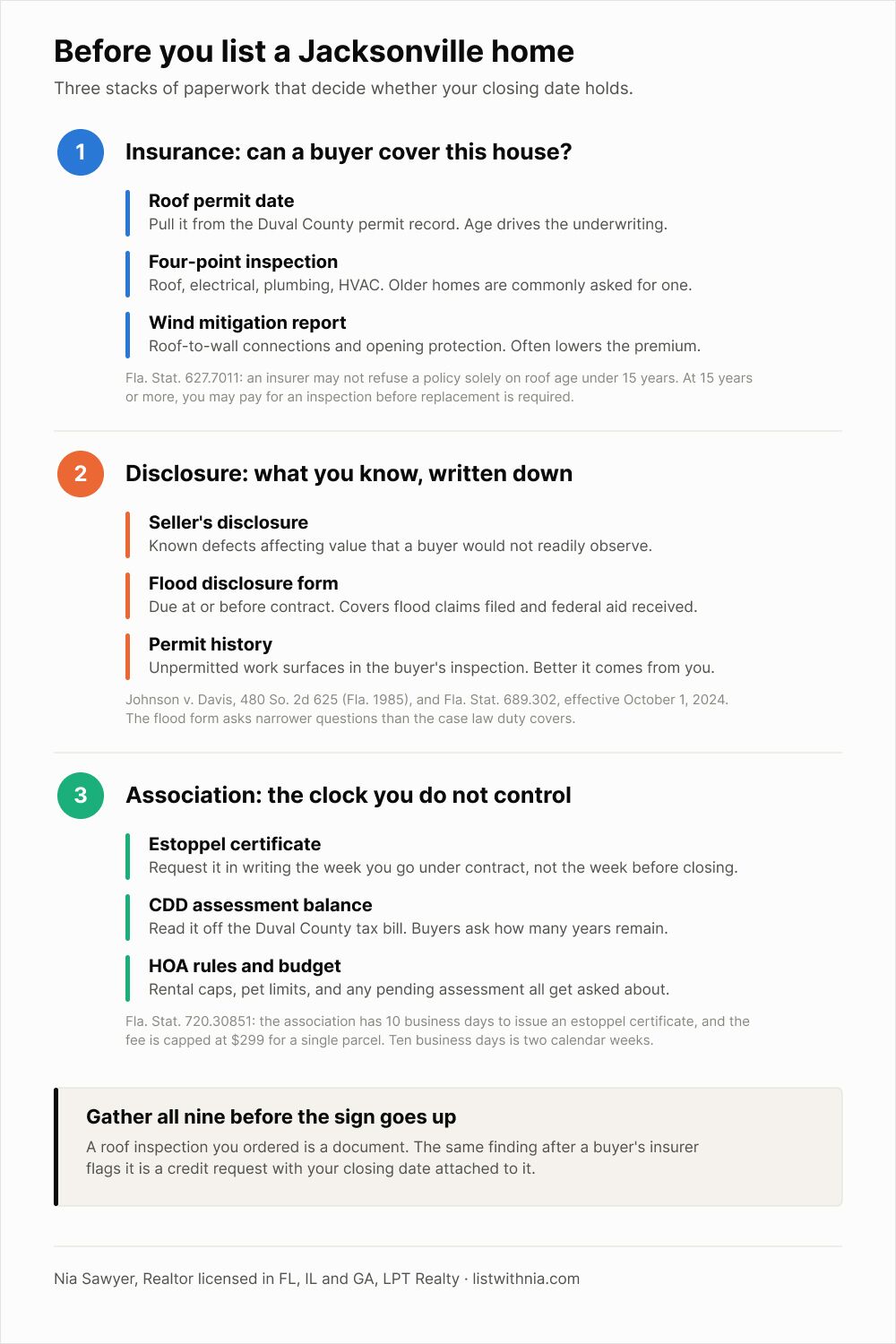
Roof age drives most of it. Under Florida Statute 627.7011, an insurer may not refuse to issue or renew a policy solely because of roof age when the roof is less than 15 years old.
Once a roof passes 15 years, the insurer must let the homeowner pay for an inspection by an authorized inspector before requiring replacement, and may not refuse solely on age if that inspection shows five or more years of useful life left. Licensed roofing contractors were added to the list of authorized inspectors in July 2024.
Knowing the rule is not the same as clearing the underwriting. Carriers still price and decline on their own criteria, and a 16-year-old shingle roof on an otherwise sound house can stall a deal that a current inspection report would have kept moving.
The fix: before listing, pull the roof permit date, and get a four-point inspection and a wind mitigation report if the home is older. A wind mitigation report documenting roof-to-wall connections and opening protection often lowers the buyer’s quoted premium, which makes your home cheaper to own without touching the price.
Sellers in Mandarin, Riverside, and the beaches communities have handed me these reports up front, and it shortens the insurance conversation to a day instead of a week.
3. Treating the disclosure as paperwork
Florida gives sellers two separate obligations, and people tend to know about the narrower one.
The broader duty comes from case law. Under Johnson v. Davis, 480 So. 2d 625 (Fla. 1985), a seller who knows facts that materially affect the property’s value, where those facts are not readily observable and not known to the buyer, has a duty to disclose them. That covers the repaired sinkhole activity, the slab leak from 2021, the roof that leaks in one corner during a hard summer storm.
The narrower one is newer. Since October 1, 2024, Florida Statute 689.302 requires residential sellers to give the buyer a flood disclosure form at or before the contract is signed. It asks whether you have filed a flood insurance claim on the property and whether you have received federal flood assistance, and it carries a notice that standard homeowners policies exclude flood damage.
Read that scope carefully, because the form asks less than sellers assume. Filing no claim does not mean you have nothing to disclose. If water came into the house and you paid for the repair yourself, the flood form may not ask, and Johnson v. Davis still does.
The fix: write down everything you know about the house, including what you fixed, then let your agent and your closing attorney decide what belongs where. Disclosed problems get negotiated. Undisclosed ones can come back as a claim long after you have spent the proceeds.
Nothing here is legal advice, and a real estate attorney is worth the hour on anything unclear.
 General guidance for Duval County sellers. Every property differs, no sale price or timeline is guaranteed, and this is not legal advice.
4. Underestimating the association paperwork clock
If your home sits in an HOA or a community development district, someone has to produce documents before you can close, and that someone does not work for you.
Under Florida Statute 720.30851, an association has 10 business days from a written request to issue an estoppel certificate, the document confirming what you owe. The fee is capped at $299 for a single parcel, and an association that misses the 10-day window may not charge for that certificate at all.
Ten business days is two calendar weeks. On a 30-day cash close, ordering it late is how a closing date slips.
CDD assessments deserve their own attention in Jacksonville. Buyers looking at newer communities in Nocatee, Bartram Park, or over the county line in St. Johns and Clay increasingly know to ask what portion of the tax bill is a CDD assessment and how many years remain on the bond.
Sellers who can answer that in a sentence keep the conversation moving. If you need the mechanics, I explain them in what CDD fees are in Jacksonville and how they work.
The fix: request the estoppel and the association documents the week you go under contract, not the week before closing. Pull your CDD balance from the Duval County tax bill at the same time.
5. Rushing the first two weeks
Your listing gets its largest audience in the first 7 to 14 days, when every saved search in your price band delivers it as new. That audience arrives once.
Phone photos taken at 2pm with the blinds half open spend that audience. So does a listing that goes live before the carpets are cleaned, or one with showing restrictions so tight that a relocating buyer flying in for a weekend cannot get inside.
The fix: hold the listing until photography, decluttering, and touch-up paint are finished, then open showing access as wide as your household can tolerate for those two weeks. A listing delayed four days and presented well generally outperforms one that went live early and got seen in that condition by everyone searching.
6. Judging an offer by the price alone
The highest number on the table is not always the offer that closes. Two contracts at $360,000 can carry different amounts of risk, and the difference lives in the terms.
The contract price is also not your proceeds. Florida charges documentary stamp tax on the deed at $0.70 per $100 of consideration in every county except Miami-Dade, per the Florida Department of Revenue, which is customarily the seller’s cost though the contract can assign it either way.
On a $350,000 Duval County sale that line alone runs $2,450, before title charges, prorated property taxes, association dues, and your mortgage payoff. Ask for a written net sheet on every offer you are seriously weighing.
| What to read on the offer | Why it matters in Duval County |
|---|---|
| Financing type and lender | FHA and VA appraisals carry property condition requirements; a local lender is generally easier to keep on schedule |
| Appraisal gap language | Says who covers the difference if the appraisal lands under contract price |
| Inspection period length | A 15-day window on a 30-day close leaves little room to renegotiate anything |
| Insurance contingency | Increasingly common in Florida, and it lets a buyer exit if quotes come back high |
| Closing date and occupancy | A date that matches your next purchase is worth real money if you are buying elsewhere |
| Proof of funds or pre-approval | A verified pre-approval is a stronger signal than a pre-qualification letter |
The fix: ask your agent to lay the offers side by side on terms, not just price, and to call each lender. Sellers coordinating a move to another state have an extra variable, and the relocation planning page covers sequencing a Jacksonville sale against a purchase elsewhere.
7. Letting a listing sit without changing anything
The most expensive of the Jacksonville home selling mistakes is the passive one. Weeks pass, showings thin out, and nothing about the listing changes except its age. Buyers arriving in week eight build their offer around your days on market rather than your comps.
Your listing sends useful signals early. Read them:
| What you are seeing | What it usually points to | Reasonable response |
|---|---|---|
| Few showings in the first 10 days | Price sits above the bracket buyers are searching | Reduce enough to clear the next bracket down |
| Steady showings, no offers | The home or the photos do not match the number | Address condition or presentation before touching price |
| Showings stop after inspections | Something in the report is scaring buyers off | Get your own inspection and price the repair honestly |
| Offers only well under list | Buyers value the home below your list price | Weigh them against your adjusted comps |
| Contract signed, insurance quotes come back high | Roof age or flood zone is driving the premium | Supply wind mitigation documentation, or negotiate |
Treat these as patterns rather than rules. They hold up reasonably well across Duval County and nearby communities in Clay, St. Johns, and Nassau, and any individual listing can still run against them.
The fix: decide in advance what day 21 means and what you will do about it. One meaningful adjustment usually costs less than three small ones spread across two months, because a long chain of reductions in the public price history invites buyers to wait for the next one.
Which Jacksonville home selling mistakes are costing you the most?
Most of these Jacksonville home selling mistakes share a root: work that could have happened before listing gets deferred until it becomes a negotiation instead. The roof inspection you order in June is a document. The same finding surfacing in September, after a buyer’s insurer flags it, is a credit request with your closing date attached to it.
For the wider picture across Duval County and the neighboring First Coast counties, the Jacksonville real estate guide goes deeper on what moves value here, and if you are still weighing whether to sell or hold, the rent versus buy breakdown runs the other side of the math.
Wondering which of these applies to your house specifically? Email Nia at listwithnia@gmail.com and you’ll get a pre-listing walkthrough covering your roof and insurance exposure, your association documents, and a price built on closed sales near your address.
As a Realtor licensed in Florida, Illinois, and Georgia with LPT Realty, Nia helps Duval County sellers get the surprises out of the way early, on whatever timeline suits your plans.