What is a CDD fee, and why does it matter when buying a home in Jacksonville?
A CDD fee is an annual assessment that helps repay the cost of building a planned community’s roads, utilities, and amenities, and it’s collected on your county property tax bill. In and around Jacksonville, CDD fees commonly add anywhere from about $1,000 to $4,000 or more a year, and they don’t show up in a home’s list price. Knowing the number before you make an offer keeps your monthly budget honest.
If you’re shopping newer communities in Duval or St. Johns County, this is one of the line items that surprises buyers most, especially people moving in from out of state. This guide covers how CDD fees work, what they cost locally, and how to check the figure before you commit.
Table of Contents
What is a CDD fee, exactly?
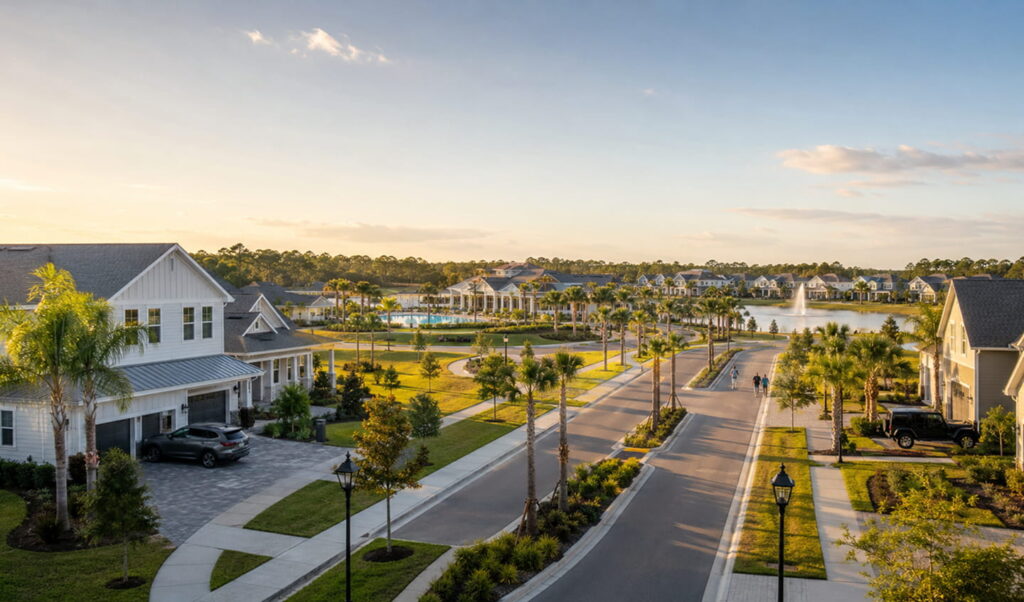
A Community Development District (CDD) is an independent, special-purpose local government created under Florida Statutes Chapter 190. Developers use it to finance the infrastructure of a new community, such as roads, drainage, water and sewer lines, and shared amenities, by issuing tax-exempt bonds instead of paying for everything upfront.
You, as the homeowner, repay your share over time through an annual CDD assessment. That assessment appears on the property tax bill mailed by the county each November, alongside your regular property taxes.
The key thing to understand: a CDD fee is not the same as your property taxes, and it’s not the same as an HOA fee. It can sit on top of both.
How much are CDD fees in Jacksonville and Nocatee?
How much do CDD fees cost near Jacksonville? It depends on the community, the builder, and even the specific lot, but most local assessments fall somewhere between about $1,000 and $4,000 a year.
A concrete local example: in Nocatee, the large planned community straddling St. Johns County just south of Jacksonville, fees vary by neighborhood and homesite. In the River Landing at Twenty Mile neighborhood, the CDD assessment runs roughly $3,285 to $3,446 a year, with the exact figure tied to the width of the homesite, according to Nocatee’s CDD resources.
| Community type | Typical annual CDD range |
|---|---|
| Established neighborhoods (no CDD) | $0 |
| Newer Duval communities (e.g., eTown) | ~$1,200–$2,400 |
| Larger amenity-rich communities (e.g., parts of Nocatee, St. Johns County) | ~$3,000–$4,000+ |
Ranges are illustrative; always confirm the figure for the specific home. CDD assessments vary from neighborhood to neighborhood and builder to builder.
Older, established areas like Riverside, Avondale, San Marco, and Ortega generally don’t carry CDD fees at all, because their infrastructure was built and paid for long ago. CDDs are mostly a newer-construction phenomenon.
The two parts of your CDD fee
Your annual CDD assessment is really two charges bundled together. Understanding the split matters, because one part eventually ends and the other doesn’t.
1. The bond (debt service) portion. This repays the bonds that funded the community’s infrastructure. It has a fixed term, often 15, 20, or 30 years from when the bonds were issued. Once it’s paid off, that portion drops away.
2. The operations and maintenance (O&M) portion. This covers the ongoing upkeep: maintaining roads, mowing the parks, running the amenities. It has no expiration, because someone always has to keep the community running.
So a $3,000 annual CDD fee today might fall by a meaningful amount once the bond is retired, but it won’t disappear entirely. Ask how many years remain on the bond for any home you’re considering.
CDD vs. HOA: what’s the difference?
Buyers mix these up constantly. They’re separate charges that can both apply to the same home.
| CDD fee | HOA fee | |
|---|---|---|
| What it funds | Public infrastructure: roads, drainage, utilities, parks | Private community management: rules, amenity operations, upkeep |
| Who collects it | The county, on your property tax bill | The homeowners association, billed separately |
| Can it expire? | The bond portion can; O&M does not | No |
In a master-planned community, you can pay both. A newer home might carry, for illustration, around $4,000 in property taxes, $2,500 in CDD fees, and $1,800 in HOA dues. That’s roughly $8,300 a year, or close to $700 a month, before your mortgage payment even starts.
How CDD fees change your monthly budget
A CDD fee can add roughly $100 to $300 a month to the cost of owning a home, and because it rides on your property tax bill, it usually gets folded into your escrow and your monthly mortgage payment.
That’s why two homes at the same list price can cost very different amounts each month. When we shop together, you’ll see the real monthly cost of each home, CDD fee included, before you fall for the kitchen. If you’re relocating to the area, this is exactly the kind of carrying cost we build into your budget on day one. See how a coordinated move works →
How to check the CDD fee before you buy
You don’t have to guess. Here’s how to confirm the number on any Jacksonville-area home:
1. Ask for the figure in writing. The listing agent or builder can provide the current annual CDD assessment for that specific lot.
2. Pull the property tax record. The Duval County or St. Johns County property appraiser and tax collector records show the assessment on the tax bill.
3. Confirm the bond term. Find out how many years of bond payments remain, so you know when that portion may drop off.
4. Add it to your true monthly cost. Combine CDD, property tax, insurance, and any HOA dues to see the real number.
This is part of the math I run on every property a buyer shortlists, so the budget is real before the touring starts. You can read more about local buying and selling on the Jacksonville real estate guide.
Jacksonville CDD fee FAQs
Do all Jacksonville homes have CDD fees?
No. CDD fees are tied to newer planned communities. Many established Jacksonville neighborhoods have no CDD at all. If avoiding one matters to you, we can focus your search accordingly.
Do CDD fees ever go away?
The bond portion does, once the infrastructure debt is repaid, typically after 15 to 30 years. The operations and maintenance portion continues as long as the district exists.
Are CDD fees tax deductible?
Generally, the portion treated as a non-ad-valorem assessment is not deductible the way property taxes can be, but tax treatment depends on your situation. Confirm with a tax professional.
Is a home with a CDD fee a bad deal?
Not necessarily. A CDD fee pays for amenities and infrastructure many buyers want. The point isn’t to avoid CDDs, it’s to know the cost and factor it into your decision instead of being surprised by it later.
Should a CDD fee change your decision?
A CDD fee isn’t a hidden trap, but it is a real cost that a list price won’t show you. Once you know what it funds, how much remains on the bond, and what it adds each month, you can compare Jacksonville-area homes on equal footing. That’s the goal: decisions made with the full number in front of you.