So what is Florida Amendment 3, and what would it do to your Jacksonville property taxes?
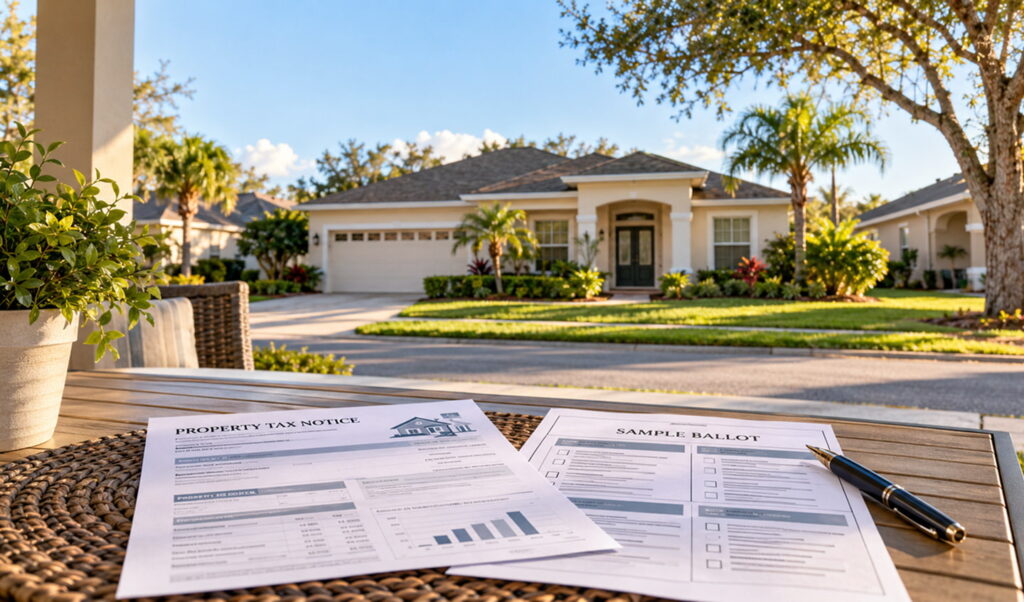
Florida Amendment 3 is the homestead property tax measure on the November 3, 2026 ballot. If at least 60% of voters approve it, the homestead exemption on non-school taxes would rise from $51,411 today to $150,000 in 2027 and $250,000 in 2028, which would shrink the non-school portion of most Duval County homestead tax bills. School taxes would not change, and people who become Florida residents after December 31, 2026 would wait until their fifth year of homestead for the larger exemption.
This guide covers what the amendment would change, what it could save on a Duval County home, who it treats differently, and what each side argues. It does not tell you how to vote.
One housekeeping note: the 2024 ballot also carried an Amendment 3, on an unrelated subject. This one is the 2026 homestead property tax measure.
Table of Contents
What does Florida Amendment 3 change?
Florida Amendment 3’s biggest change is to the homestead exemption, the slice of a primary residence’s assessed value that property tax doesn’t touch. Here is what the revised ballot summary says it would do, with timing details from the Volusia County Property Appraiser’s Amendment 3 FAQ:
• A bigger exemption on non-school taxes. $150,000 starting January 1, 2027, and $250,000 starting January 1, 2028, adjusted for inflation from 2029. Today’s exemption is $51,411.
• School taxes keep the $25,000 exemption. The increase applies to city, county and other non-school taxes only.
• A slower track for new residents. People who are not Florida residents on December 31, 2026 would get the existing exemption when they qualify, and the larger one starting with their fifth year of exemption.
• A lower cap for non-homestead property. Yearly assessment increases on rentals, second homes and commercial property would be capped at 5% instead of 10% for non-school taxes.
• Room for local governments to go further. The Legislature would set up a process letting counties and cities raise the exemption up to a home’s full assessed value, and special districts could do the same with voter approval.
• Limits on how property taxes get spent. Counties and cities would have to use them “solely for public safety, education and schools, infrastructure, natural resources, bond debt service, retirement benefits for employees, and operations and administration,” though county officers or a county or city governing body can approve other spending unless state law prohibits it.
Two things stay the same. Save Our Homes, which limits how fast a homestead’s assessed value can climb, is unchanged, and so is portability, which lets you carry those savings to your next Florida home.
If Florida Amendment 3 passes, it takes effect January 1, 2027. According to the Volusia FAQ, you would first see it on the August 2027 TRIM notice and the tax bill that arrives in November 2027.
Why the ballot wording may look different from what you heard this summer
The Legislature’s original title was “Save Our Homes From Excessive Property Taxes.” On August 3, Leon County Circuit Judge David Frank ruled the title and summary “clearly and conclusively defective” and likened the title to “a political slogan,” WLRN reported. Attorney General James Uthmeier rewrote it as “Increased Homestead Exemption; Lower Cap on Increases in Non-Homestead Property Assessments.”
The proposal underneath stayed the same. As Uthmeier put it, “we don’t have the ability to rewrite the full amendment, just the ballot summary and title.”
How much would Amendment 3 save on a Jacksonville tax bill?
At today’s tax rates, a homestead in the City of Jacksonville would save up to about $1,120 a year in 2027 and up to about $2,260 a year from 2028. Your number depends on your home’s assessed value, which is often lower than what the house would sell for.
The savings come only from non-school taxes. In most of Duval County, that means the City of Jacksonville’s rate of 11.1919 mills, which the City Council kept when it adopted the 2026-27 budget in September, plus 0.1793 mills for the St. Johns River Water Management District. Together that’s about 11.37 mills, or $11.37 for every $1,000 of taxable value. A small Florida Inland Navigation District levy adds a few dollars more.
The math is three steps: take your assessed value, subtract the exemption, and multiply by the rate.
| Assessed value | Non-school tax today ($51,411 exemption) | 2027 ($150,000 exemption) | 2028 ($250,000 exemption) | Yearly savings by 2028 |
|---|---|---|---|---|
| $150,000 | $1,121 | $0 | $0 | $1,121 |
| $193,236 (2025 Duval median homestead) | $1,613 | $492 | $0 | $1,613 |
| $300,000 | $2,827 | $1,706 | $569 | $2,258 |
| $400,000 | $3,964 | $2,843 | $1,706 | $2,258 |
Our calculation, using 11.3712 mills (City of Jacksonville plus the water management district), 2026 exemption amounts, and assessed values held flat. School taxes are left out because Florida Amendment 3 doesn’t change them. Real 2027 and 2028 bills will depend on the rates local governments set in those years.
Once a home’s assessed value reaches $250,000, the savings stop growing, because the added exemption is the same size for everyone above that line. Homes assessed at $150,000 or less would owe nothing in non-school taxes as early as 2027. The Volusia County Property Appraiser also notes that recent buyers, whose assessed values sit closer to market value, “may be more likely to receive the full benefit.”
The median row comes from Jacksonville City Council Auditor Philip Peterson, who told Jacksonville Today that the median assessed value of homesteaded single-family homes in Duval was $193,236 in 2025. Even if Save Our Homes allowed the full 3% increase every year, that home would be assessed around $211,000 by 2028 by our math, still under $250,000. Under the amendment, the typical Duval single-family homestead would owe no non-school property tax and would keep paying school taxes and any non-ad valorem fees.
Use your assessed value, not your home’s market value
You’ll find your assessed value on the TRIM notice the Duval County Property Appraiser mails in mid to late August each year. For anyone who has owned for a while, it’s usually well below what the house would sell for, because Save Our Homes limits a homestead’s yearly increase to 3% or the change in CPI, whichever is less. Running the math on an online value estimate gives you the wrong answer.
If you’re buying, keep this in mind when you read a listing. The tax bill you see reflects the seller’s exemptions and years of capped increases. The Property Appraiser’s Save Our Homes page says that at the end of the sale year “all of the seller’s exemptions and cap are removed,” and Section 193.155(3) of the Florida Statutes has the home reassessed at just value as of January 1 of the following year.
Estimate your taxes from the price you’ll pay. Our Jacksonville closing costs guide covers how the current year’s taxes are split at closing.
Does Amendment 3 work the same in Clay, St. Johns and Nassau counties?
The exemption amounts are the same statewide, so a homeowner in Orange Park, St. Augustine or Fernandina Beach gets the same $150,000 and $250,000 figures. The dollar savings differ because each county and city sets its own rates. Run the same three steps with the rates on your own TRIM notice.
Inside Duval, the table uses the rate for most of Jacksonville. The City of Jacksonville’s rate is lower in the Beaches towns, at 7.9012 mills, and in Baldwin, at 9.4208 mills, according to Jacksonville Today. The larger exemption applies to every non-school levy on your bill, so read your exact rates off your own TRIM notice.
One cost the amendment won’t touch is a Community Development District fee, which shows up in newer communities like Nocatee in St. Johns County and Oakleaf in Clay County. The Duval County Property Appraiser defines an exemption as a reduction to assessed value, and a non-ad valorem assessment as a charge “not based on your property’s value and millage.” A bigger exemption therefore leaves a CDD fee where it is. Our guide to CDD fees in Jacksonville explains how those fees work.
What changes if you’re moving to Jacksonville after 2026?
If you become a Florida resident after December 31, 2026, Florida Amendment 3 starts you on the existing exemption of about $50,000. The larger exemption begins in your fifth year with a homestead exemption. The Volusia County Property Appraiser describes it as $50,000, adjusted for inflation starting in 2028, with the larger amount applying “beginning January 1 of the fifth year.”
Here’s how that could play out. Say you move from Chicago in mid-2027, buy a home in Duval County, and first qualify for homestead for 2028. By our reading of the summary, your exemption years 2028 through 2031 would use the smaller amount, and the larger one would start in 2032. The Volusia FAQ adds that implementing legislation may set additional procedures, so the details could shift.
During those four years, a long-time neighbor with the same assessed value of $250,000 or more would pay about $2,270 a year less in non-school taxes than you would at today’s rates. That’s our arithmetic: a $200,000 difference in exemptions times 11.37 mills. It comes on top of the Save Our Homes gap that newer buyers already face.
Two questions are still open:
• The rule may be challenged. The ballot summary applies the new-resident rule only “to the extent permitted by the US Constitution,” which leaves room for a court fight.
• How current Florida renters are treated. The summary’s cutoff refers to “Florida residents.” The Volusia County Property Appraiser reads it that way: people who “establish Florida residency by December 31, 2026, would be eligible for the higher exemption amount when they do choose to purchase.” Bilzin Sumberg, a Florida law firm, reads it the same way and lists typical evidence of residency, such as a Florida driver’s license, voter registration and a declaration of domicile. The Florida Policy Institute, which opposes the amendment, reads the underlying resolution as tying residency to owning a homestead, which would put renters who buy after 2026 on the slower track.
Some coverage frames December 31 as an important deadline. Moving to Florida early, or buying sooner than you planned, because of a ballot measure that needs 60% to pass and whose details aren’t yet written into law is a lot to hang on one vote. If a move this year already makes sense for you, the timing may help. If it doesn’t, the amendment alone is a thin reason to rush.
Take residency questions to the Duval County Property Appraiser’s office and a Florida real estate attorney. Our Chicago to Jacksonville moving guide covers the homestead filing itself.
Does Amendment 3 lower school property taxes?
No. School taxes keep only the $25,000 homestead exemption, and the Volusia FAQ notes that school taxes on non-homestead property would stay uncapped.
Duval voters will also see a separate school tax question on the same ballot. It asks whether to continue Duval County Public Schools’ 1-mill operating levy from July 1, 2027 through June 30, 2031, according to the district’s posted ballot language. Florida Amendment 3 has no effect on that levy, whichever way either vote goes.
What does Amendment 3 mean for rentals, second homes and renters?
Rentals, second homes and commercial buildings would not get the bigger exemption. Their assessed values could rise no more than 5% a year for non-school taxes, down from 10%. As WPTV noted, that cap limits assessed values, and “local tax rates could still change.”
Renters see no direct change. The indirect effect is where the two sides split. Florida Realtors CEO Margy Grant told WPTV the lower cap would give rental and commercial property owners more predictability.
Opponents argue the measure would shift costs rather than eliminate them, leaving renters, businesses and other property owners to carry more of the burden, as FOX 35 summarized the Vote No on 3 campaign’s position. If you’re weighing whether to keep renting, our renting vs. buying in Jacksonville breakdown runs the monthly numbers.
What would Amendment 3 mean for Jacksonville’s city budget?
City Council Auditor Philip Peterson estimated in June that a $250,000 exemption would likely cut city revenue by more than $300 million, according to Jacksonville Today. Based on 2025 property values instead, he put the loss at $250 million to $280 million. He said his estimate didn’t count the lower cap on non-homestead property, which would add to the loss.
For scale, the City Council adopted a roughly $2 billion budget for 2026-27 in September and held the property tax rate at 11.1919 mills on a 16-3 vote, Jacksonville Today reported. The council also parked some grant and program money in an Amendment 3 contingency fund that would move to reserves if the measure passes, to prepare for what Jacksonville Today described as an expected $300 million revenue shortfall by 2028. Mayor Donna Deegan said in June that the projected hit “kind of takes your breath away when you’re just talking about core services.”
Statewide, the state’s Revenue Estimating Conference projects the amendment would eventually reduce local non-school property tax revenue by about $11.8 billion a year, starting at roughly $4.93 billion in 2027-28, per WPTV. The debate centers on how cities and counties would cover a gap that size: cuts, fees, or higher rates on whatever is still taxable.
What are the pros and cons of Florida Amendment 3?
Supporters see tax relief that helps people afford to stay in the homes they bought. Opponents see a cost shift onto renters, businesses and fees, along with cuts to local services. Here is what each side says, in their words where possible.
What supporters say
• It’s relief for homeowners. Florida Realtors supports Amendment 3 because it “offers voters an opportunity to provide meaningful property tax relief while strengthening Florida’s commitment to attainable homeownership,” as the Florida Chamber quotes the association. The association has put $10 million behind the Vote Yes on 3 campaign, and its CEO, Margy Grant, told WPTV that “affordability doesn’t end at closing.”
• Local tax collections have grown fast. Gov. Ron DeSantis has pointed to local property tax revenue rising from $31 billion in 2019 to $55 billion in 2024, FOX 35 reported. WPTV reports he has said he will help promote the amendment “in some capacity,” though he wanted a larger cut.
• It reins in local spending. Backers say it would push local governments to trim spending, WUSF reported, and the amendment limits what counties and cities can spend property taxes on.
What opponents and critics say
• Costs move to fees and other taxpayers. “You might pay a couple of thousand dollars less for your property taxes, but you’re going to wind up paying more as the cost shifts onto fees, additional assessments,” Edie Ousley, a spokesperson for Vote No on Amendment 3, told WPTV.
• Local services take the hit. The Florida Policy Institute called it “a cost shift that would erode the property tax base, open the door to new tax increases or fees, and leave renters behind,” per WLRN. The Florida Sheriffs Association says it is “significantly concerned” about the effect on local budgets and services, according to the Florida Chamber.
• It creates two tiers of homeowners. The Florida Policy Institute argues the new-resident rule gives people who buy after 2026 a worse deal than their neighbors for four years.
An August 18 Sachs Media survey of 800 Florida voters found 63% support, three points above the 60% needed and within its margin of error of plus or minus 3.5 points, WPTV reported. Polls taken weeks before an election can move.
A note on where this guide sits: Florida Realtors, the statewide Realtor trade association, is campaigning for Amendment 3. This guide takes no position. Its purpose is to help you understand the measure and what it could do to your own tax bill.
What should Jacksonville homeowners do before November 3?
1. Find your assessed value on your 2026 TRIM notice, then run it through the table above to get a rough savings figure.
2. Read the full ballot text. The Jones Walker post linked above reproduces the revised summary word for word, and the Duval County Supervisor of Elections site has your voting details for November 3, including early voting and vote-by-mail.
3. If you’re relocating, sort out residency questions with the Property Appraiser’s office and an attorney before you change your plans.
4. If you’re buying or selling in 2027, budget on today’s rules. If the amendment passes, the savings show up later as a bonus. If it fails, your numbers still hold.
We’ll update this guide after November 3 with the result and what it means for your 2027 bill.
Should Amendment 3 change your plans to buy or sell in Jacksonville?
For most people, probably not. A move that works under today’s tax rules generally still works if Florida Amendment 3 passes, and the savings would arrive gradually on bills from late 2027 onward. The exceptions are buyers relocating from out of state, who face the four-year wait, and owners of rentals or second homes, who would get the 5% cap and no bigger exemption. If you rent in Jacksonville now and plan to buy, the renter question above applies to you, and our first-time home buyer guide for Jacksonville covers the down payment assistance programs available today.
Curious what Amendment 3 would mean for a specific home? Email Nia at listwithnia@gmail.com and you’ll get a property tax estimate for that home’s assessed value under today’s rules and under both Amendment 3 steps. As a Realtor licensed in Florida, Illinois, and Georgia with LPT Realty, Nia helps Duval County buyers and sellers plan around their tax bill, with no pressure and no opinion on how you vote.
For more on the local market, visit the Jacksonville real estate guide.