

How do Chicago vs. Atlanta property taxes compare on the same house?
On a $400,000 home, a Chicago owner typically pays roughly $7,000 to $8,000 a year while an Atlanta owner in Fulton County typically pays roughly $4,000 to $5,500. The gap comes from the tax rate and the exemptions, not from the assessment ratio, which actually favors Chicago on paper.
Why the same house is taxed so differently
Both states start from fair market value and let local governments set the rate. After that they diverge, usually in ways that surface at the closing table rather than the house hunt.
Illinois assesses low and taxes high. Georgia assesses high and taxes lower, then layers on exemptions that cap how fast your assessment can climb. Two systems, opposite designs, similar-looking homes.
Most Chicago sellers I work with who are buying in metro Atlanta expect a tax cut, and usually they get one. What catches them out is when the bills arrive and which piece of the Atlanta bill is protected from increases. Those two shape the first two years more than the headline rate does.
How is a Chicago property tax bill calculated?
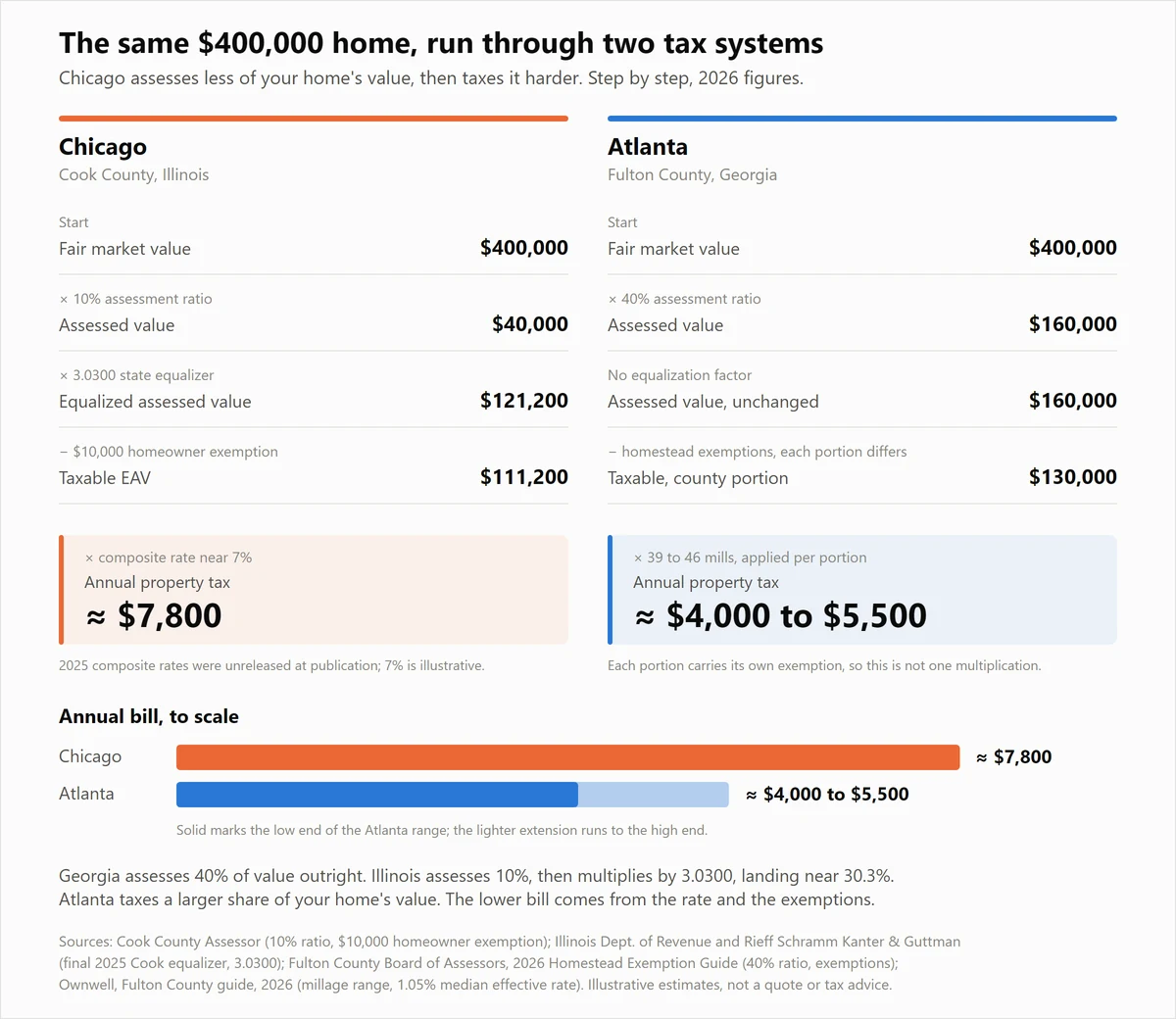
Cook County runs a four-step calculation, and the middle step is the unusual one. According to the Cook County Assessor’s Office, “the assessed value equals 10% of the fair market value of the home.” That assessed value is then multiplied by a state equalization factor to produce the Equalized Assessed Value, exemptions come off the EAV, and the local composite rate is applied to what’s left.
That equalizer is set annually by the Illinois Department of Revenue to bring county assessments up to a statewide benchmark. The tentative 2025 factor was 2.8683, announced April 29, 2026; the final 2025 factor landed higher at 3.0300 in June 2026, per Chicago property tax firm Rieff Schramm Kanter & Guttman.
Here’s the part that trips up buyers: Illinois bills property taxes a year in arrears. The 2025 factor drives bills payable in 2026, so if you close in Chicago this year, the bill arriving covers last year. That is why proration at closing matters on an Illinois purchase.
So on a $400,000 Chicago home:
➤ Fair market value: $400,000
➤ Assessed value at 10%: $40,000
➤ Equalized Assessed Value at 3.0300: $121,200
➤ Less the $10,000 Homeowner Exemption: $111,200
➤ Times a composite rate around 7%: roughly $7,800 a year
Composite rates are set by the Cook County Clerk, and the 2025 rates had not been released as of this writing, so treat that last line as illustrative. The steadier number is the effective rate: about 1.8% to 2.0% of value in the city, per the Cook County property tax overview (SmartAsset, 2026), with many suburbs in Cook, DuPage, and Lake counties running higher.
How is an Atlanta property tax bill calculated?
Georgia is simpler on its face and more layered underneath. Assessed value is fixed by statute: the Fulton County Board of Assessors confirms in its 2026 Homestead Exemption Guide that “the assessed value in Georgia is, by statute, 40% of the fair market value.”
Note what that means against Chicago. Illinois assesses at 10% but multiplies by 3.03, landing near 30.3% of value. Georgia assesses 40% outright. Atlanta actually taxes a larger share of your home’s value than Chicago does. The lower bill comes from the rate and the exemptions, not the assessment.
Fulton’s basic homestead exemption takes $30,000 off the assessed value on the county portion and $2,000 off school. City of Atlanta residents also get $30,000 off City Operations, the City Park Fund, and City School. Combined millage inside the city runs roughly 39 to 46 mills once county, city, school, and any bond or special district levies are stacked, and Fulton’s median effective rate is about 1.05%, per Ownwell’s Fulton County guide (2026).
On the same $400,000 home, an Atlanta owner in Fulton County generally lands somewhere around $4,000 to $5,500 a year depending on exemptions and exactly which jurisdictions serve the address.
Why your Atlanta address matters more than your price
Fulton County contains 18 separate taxing jurisdictions, and per the county’s own 2026 assessment guidance, “each of the 18 taxing jurisdictions in Fulton County, including cities, school boards and Fulton County Government, will set its own separate millage rate.” Your county, your city, and your school system each set their own rate and run their own homestead exemptions.
That fragmentation matters right now because of a state law called HB 581, which created a floating homestead exemption capping how fast your taxable value can grow. Counties, cities, and school districts could each opt out independently by March 1, 2025, and they did not all choose the same way. Both the City of Atlanta and Atlanta Public Schools opted out, according to the Tax Foundation.
Fulton County itself still works with the state exemption. Its 2026 guide explains that where a local floating exemption also exists, “the taxpayer will receive whichever of the two exemptions is more beneficial,” calculated automatically by the taxing authority.
Fulton’s own local version, the CPI Homestead Freeze created by Senate Bill 610 back in 2004, limits the annual increase in your assessment to the lesser of CPI or 3%. The City of Atlanta’s local floating exemption uses a base value that rises 2.6% a year.
The practical result: slices of one Atlanta tax bill grow at different capped rates, and one slice is uncapped. A Chicago buyer used to one consolidated bill rarely expects that.
Chicago vs. Atlanta property taxes at a glance
| Factor | Chicago (Cook County) | Atlanta (Fulton County) |
|---|---|---|
| Assessment ratio | 10% of fair market value | 40% of fair market value |
| Equalization factor | 3.0300 for 2025 (IDOR) | None |
| Effective share of value assessed | ~30.3% | 40% |
| Basic homestead relief | $10,000 off EAV | $30,000 off county, $2,000 off school |
| Assessment growth cap | None | Lesser of CPI or 3% (county); 2.6% (city) |
| Billing timing | One year in arrears | Current year |
| Rough annual bill, $400,000 home | ~$7,000–$8,000 | ~$4,000–$5,500 |
| State income tax, 2026 | 4.95% flat | 4.99% flat |
Does moving to Georgia cut your income tax too?
Barely, and this surprises almost everyone. Georgia’s flat rate dropped to 4.99% for 2026 under HB 463, down from 5.19%, per the Georgia Department of Revenue. Illinois sits at 4.95% flat, per the Illinois Department of Revenue.
Georgia is four hundredths of a point higher. If you’re moving from Chicago to Atlanta expecting an income tax win, the win is on property tax and housing cost, not on your paycheck. Georgia phases in further cuts and raises the retirement income exclusion in 2027, so retirees see a different picture.
What changes in Atlanta in 2027
The opt-out gap is closing. SB 33, the Homeownership Opportunity and Market Equalization Act of 2026, makes the HB 581 cap mandatory for all counties, cities, and school systems, with the relevant provisions applicable on and after January 1, 2027, according to the Georgia Municipal Association.
In plain terms: 2026 is the last year Atlanta’s city and school portions sit outside the inflation cap. Worth knowing when you model years two and three.
Three things to do before you close
These come up with every client moving between the two markets. None of it is tax advice; confirm your specific numbers with the county and a tax professional.
1. Apply for homestead by April 1. Fulton’s deadline is April 1, though SB 566 now lets you file through the 45-day appeal window following your assessment notice. Miss it entirely and you pay unexempted for a year.
2. Re-apply if the deed changes. Fulton’s guide is explicit that exemptions auto-renew, but “if the names on the deed change, even if the same people live in the home, the person listed on the deed who occupies the property will need to re-apply.” Buyers inherit the house, not the seller’s exemption.
3. Check the notice for exemptions you don’t qualify for. Under SB 566, failing to report ineligibility for an exemption listed on your notice can trigger back taxes, interest, and a 50% penalty.
On the Chicago side, budget for the arrears cycle. Your first Illinois bill covers a year you may not have owned the home, and proration at closing settles it.
If you’re planning the move itself, moving from Chicago to Atlanta walks the sequence, how county lines change your monthly payment covers the Fulton, DeKalb, and Cobb differences, and the relocation planning page is where I coordinate sell-here-buy-there moves.
Chicago vs. Atlanta property taxes: your questions answered
Are property taxes lower in Atlanta than Chicago?
Generally yes. On a $400,000 home, Chicago typically runs about $7,000 to $8,000 a year against roughly $4,000 to $5,500 in Fulton County, though your exact Atlanta figure depends on which of the county’s 18 taxing jurisdictions serve your address.
Why does Georgia assess at 40% and Illinois at 10%?
They are not comparable on their own. Illinois multiplies its 10% assessment by a state equalization factor, 3.0300 for 2025, which lands near 30.3% of value. Georgia’s 40% is applied directly with no multiplier.
Does Atlanta cap how much my property taxes can rise?
Partly. Fulton County’s exemption caps assessment growth at the lesser of CPI or 3%, and the City of Atlanta’s base value rises 2.6% a year, but the City of Atlanta and Atlanta Public Schools opted out of the statewide cap. SB 33 makes the cap mandatory for everyone from January 1, 2027.
When are property taxes due in each city?
Cook County bills a year in arrears, so the bill you receive covers the prior tax year. Georgia bills for the current year. Plan your closing proration accordingly.
Which number should actually drive your decision?
The annual bill matters less than the growth rate over the years you’ll own. A higher Chicago bill and a capped Atlanta bill can diverge considerably across a decade, and Atlanta’s uncapped slices behave differently again until 2027. Model the first five years, not just year one.
Curious what your specific numbers would look like on both ends of the move? Email Nia at listwithnia@gmail.com and you’ll get a side-by-side tax estimate built on your actual Chicago address and the metro Atlanta areas you’re considering.
As a Realtor licensed in Florida, Illinois, and Georgia with LPT Realty, Nia handles both ends of a Chicago to Atlanta move at a pace that suits your plans, not a sales pitch.