
How do you avoid overpricing or underpricing your Atlanta home?
Pricing your Atlanta home well starts with recent comparable sales inside a half mile of your address, adjusted for the things that move value here: the county line, condition, and BeltLine access. Then price into a buyer search bracket rather than to a round number, and set your review triggers before the sign goes up. In a metro carrying more inventory than it did a year ago, the first two weeks decide most of the outcome.
The Atlanta market that your list price has to survive
Atlanta gave sellers a wide margin for error from 2020 through 2023. That margin is thinner now.
In the Atlanta Core, the median sales price was $420,000 in June 2026, up 0.7% year over year, with 22,707 active listings, up 0.6%, according to the Georgia MLS June 2026 market report.
Statewide, sellers closed 2025 receiving 95.4% of their original list price, down 1.0% year over year, with homes averaging 56 days on market, up 21.7%, per the Georgia REALTORS® 2025 Annual Report, which draws on 14 MLSs covering more than 92% of Georgia activity.
The shift shows up in time rather than in panic discounting. Realtor.com counted 16.7% of Atlanta listings with a price reduction in January 2026, down 0.5 percentage points year over year, against a median 73 days on market, up 10.6%, per Realtor.com market trends for Atlanta (January 2026). January runs seasonally slow, so weigh the year-over-year direction rather than the raw day count: sellers are not slashing prices across the board, they are waiting longer.
Buyers have options and time. Neither pricing mistake gets covered up by demand anymore.
What overpricing an Atlanta home actually costs
Sellers who list high plan to negotiate down. The discount arrives anyway, and it arrives larger.
Zillow’s national research found homes lingering about two months sold for roughly 5% below list price, per Zillow Research. That is a pattern across many listings rather than a measured penalty on any one home, and it is national data.
The Georgia figure sits closer to home. Sellers statewide closed 2025 receiving 95.4% of their original list price, so a home first asking $420,000 that lands on that average closes about $19,300 under its opening number, before two extra months of mortgage payments, property taxes, insurance, and utilities.
The mechanism is straightforward. In my listings, traffic runs heaviest in the first 7 to 14 days, when every buyer with a saved search in your price band sees the home as new. Price above that band and they never see it. By the time you reduce, the price history is public on every major portal, so buyers arriving at week six build their offer around your days on market rather than your comps.
Condition compounds this. Homes needing significant work are “sitting on the market longer and selling at lower average prices,” intown agent David Pruett told Rough Draft Atlanta in January 2026. An aspirational price on a home with a 20-year roof is the version I see most often.
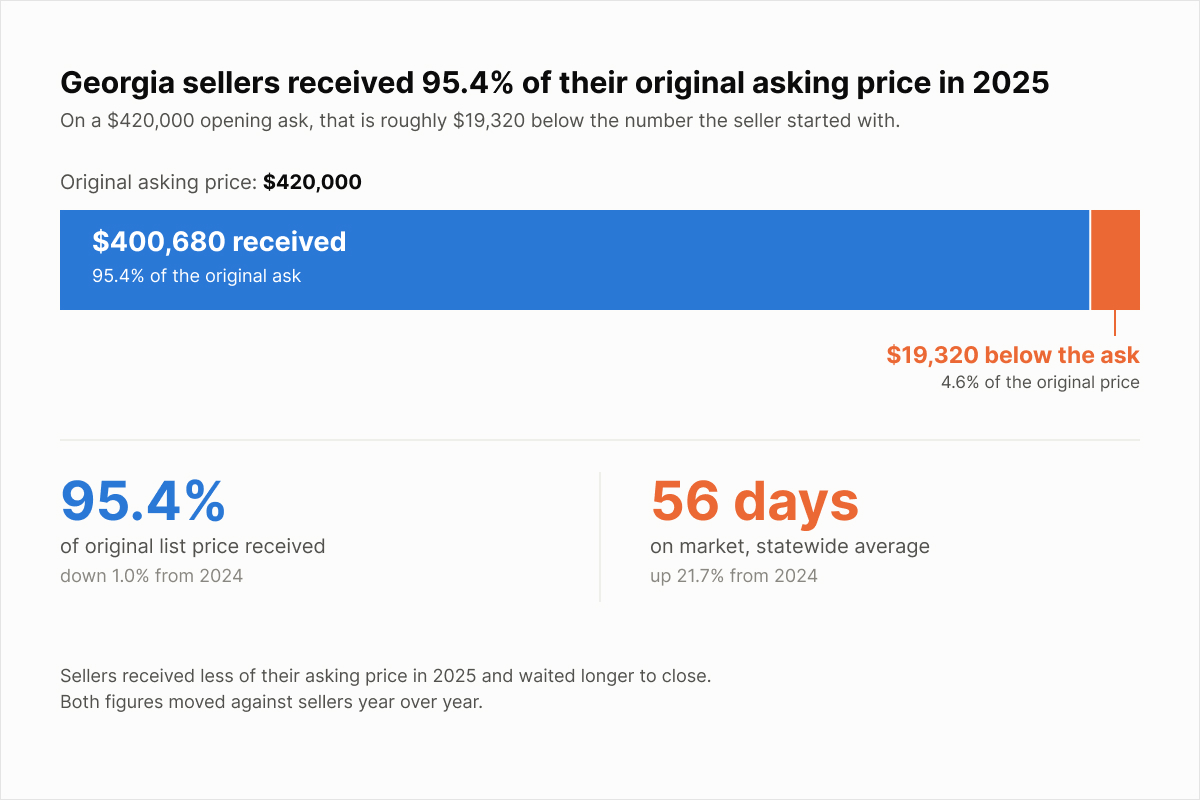 Source: Georgia REALTORS 2025 Annual Report, covering 14 MLSs and more than 92% of Georgia activity. Figures are statewide averages for calendar year 2025. The $420,000 opening ask is illustrative, matching the Atlanta Core median sale price for June 2026 per Georgia MLS. Illustration of a statewide average, not a projection for any one home.
Why underpricing is the quieter mistake
Underpricing gets less attention because it produces a fast sale, and a fast sale feels like a win. Sometimes it is one. The strategy works when enough qualified buyers see the listing in the same week to bid against each other, and that condition is not automatic in 2026.
With 22,707 active listings across the Atlanta Core in June, a buyer who likes your house at $400,000 can usually find two more at $415,000. Competition comes from scarcity in your price band, not from the metro headline.
Three things worth knowing before you deliberately list low:
✓ Appraisals cap the upside. If bidding pushes your contract $30,000 over list, the buyer’s lender still orders an appraisal. A contract above appraised value gets renegotiated, or the buyer covers the gap in cash. Neither is guaranteed.
✓ A low price filters your buyer pool. Buyers with cash or flexible terms often shop a bracket above where you listed, so your offers may be weaker on terms even when the number looks strong.
✓ Your list price does nothing for your tax bill. Georgia assesses property at 40% of fair market value, per the Georgia Department of Revenue, and the county sets that value independently of what you ask. I explain how those layers stack in buying in metro Atlanta: how county lines change your monthly payment.
Sellers on a relocation timeline sometimes underprice on purpose to buy certainty, which can be a sound trade. Make it a decision with the number in front of you rather than a default. The relocation planning page covers sequencing a sale against a purchase in another state.
A 6-step method for pricing your Atlanta home
This is the process I run before recommending a list price, in Fulton or DeKalb.
1. Pull genuine comps. Closed sales within a half mile, in the last 90 days, same property type, same county, similar square footage and condition. Active listings show the competition. Only closed sales show what a buyer paid.
2. Adjust for what moves value here. BeltLine distance, the county line running through the city, historic overlay restrictions, and crawl space condition can separate two similar houses by six figures.
3. Check absorption in your price band. Metro Atlanta ran a 4.0-month supply in March 2026, per the Atlanta REALTORS® Market Brief, but your bracket may run tighter or looser. Divide active listings in your band by monthly closings in that same band.
4. Price into a search bracket. Buyers filter in round increments. A home worth about $402,000 listed at $415,000 misses everyone capped at $400,000 and looks expensive to everyone searching $400,000 to $425,000. Listing at $399,900 pulls both groups.
5. Set your review triggers before you list. Decide now what showing counts, saved-search adds, and feedback themes at day 7, 14, and 21 will mean, and what you will do about each.
6. Decide your adjustment size in advance. Cuts that clear a search bracket generally reset the audience. Cuts of 1% or 2% signal flexibility without reaching new buyers, which invites negotiation instead of showings.
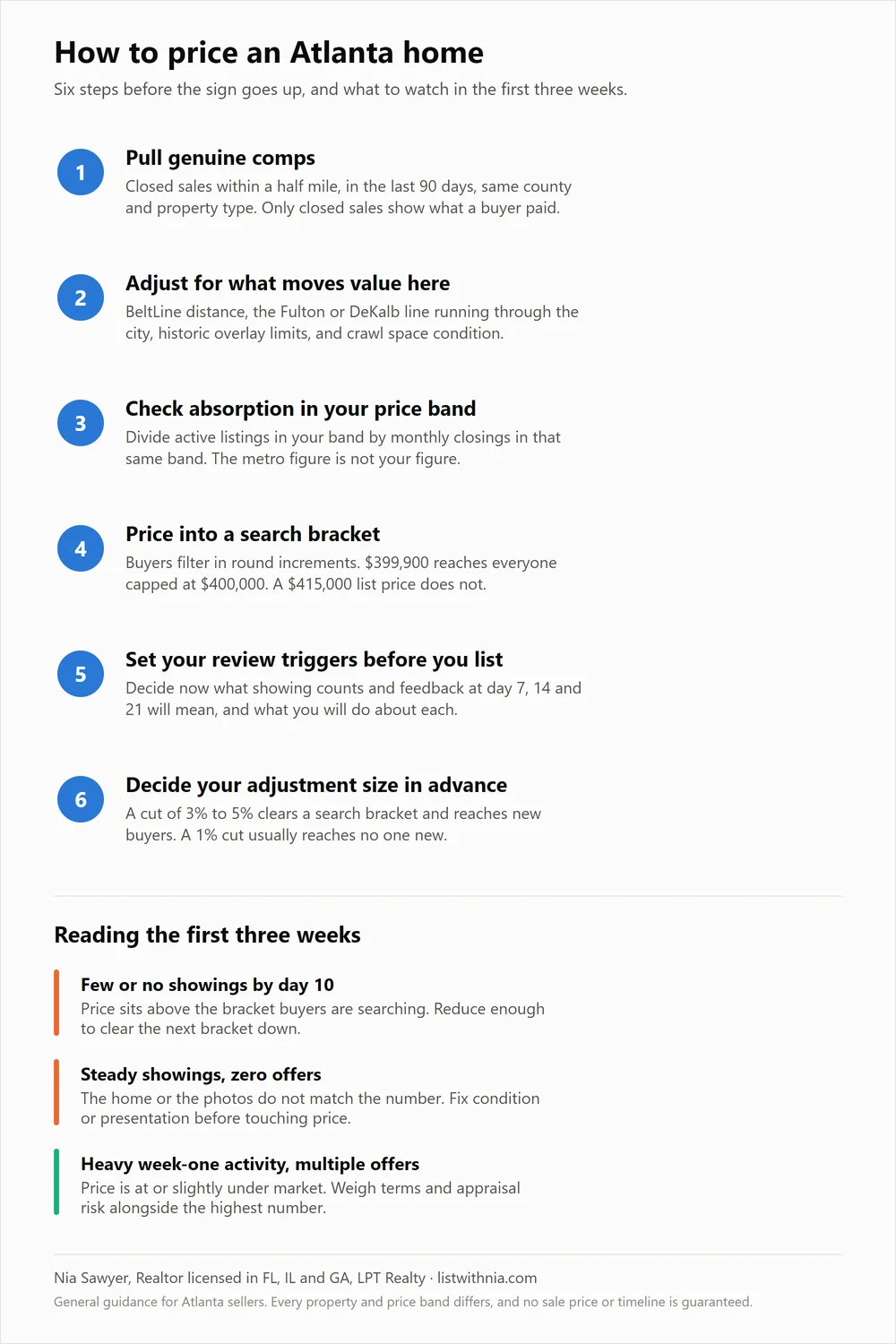
Reading the early signals: what your first three weeks are telling you
Your listing starts sending diagnostic information almost immediately.
| What you see | What it usually means | Reasonable response |
|---|---|---|
| Few or no showings in 10 days | Price sits above the bracket buyers search | Reduce enough to clear the next bracket down |
| Steady showings, zero offers | The home or the photos do not match the number | Fix condition or presentation before touching price |
| Only offers well under list | Buyers value the home below your list price | Weigh those offers against your adjusted comps |
| Heavy first-week activity, multiple offers | Price is at or slightly under market | Weigh terms and appraisal risk alongside the number |
| Contract signed, appraisal comes in low | Contract price outran documented comps | Renegotiate, dispute with more comps, or ask the buyer to cover the gap |
Treat these as patterns rather than rules. They hold up across intown Atlanta and nearby communities like Decatur, Avondale Estates, Brookhaven, and College Park, and any individual listing can still run against them.
Atlanta home pricing: FAQs
Should I price high and negotiate down?
Usually not in this market. Georgia sellers received 95.4% of their original list price in 2025, down 1.0% year over year, per the Georgia REALTORS® 2025 Annual Report, which reflects how many listings reduced before closing. Zillow’s national research points the same way, finding homes that linger around two months sold near 5% below list.
A listing draws its largest audience in the first 7 to 14 days, and a price above the buyer’s search bracket hides it from that audience entirely. Atlanta homes already sat a median 73 days in January 2026, up 10.6% year over year, per Realtor.com. Pricing at market from day one puts your home in front of the people already searching for it.
How long should my Atlanta home sit before I reduce the price?
Two to three weeks of real exposure generally gives you enough information, assuming professional photos and normal showing access. Georgia homes averaged 56 days on market in 2025, up 21.7% year over year per the Georgia REALTORS® 2025 Annual Report, so passing 30 days is common and not automatically a crisis.
Showing volume matters more than the calendar. Ten showings with no offers points at condition or presentation. Two showings points at price. A decisive adjustment at day 21 tends to cost less than a first move at day 60, when buyers can already see the price history.
How much should a price reduction be in Atlanta?
Large enough to clear the next search bracket, which usually means 3% to 5% rather than 1%. A $450,000 listing dropped to $445,000 stays invisible to buyers capped at $425,000, while $439,000 or $425,000 puts the home in front of a new set of saved searches. One meaningful reduction generally works better than three small ones, since a long chain of cuts invites buyers to wait for the next one.
Does underpricing guarantee multiple offers?
No. Multiple offers require several qualified buyers viewing your home in the same short window, which depends on inventory in your price band and property type. With 22,707 active listings across the Atlanta Core in June 2026, per Georgia MLS, buyers in most brackets have alternatives.
Underpricing can be sound when speed matters more than the last few thousand dollars, but treat it as a deliberate trade rather than a bidding-war strategy. An automated online estimate is a starting point for the conversation, not a list price, since it averages over blocks moving in opposite directions.
What is your home actually worth this month?
Pricing comes down to which comps apply to your address, what condition adjustments a buyer makes walking through, and how many homes yours competes against in your bracket this month. Two houses on the same street in Kirkwood, one with a documented crawl space repair and one without, belong at different prices.
For the wider picture across the city and nearby communities like Decatur, East Point, Sandy Springs, and Tucker, the Atlanta real estate guide goes deeper on what drives value across Fulton, DeKalb, and the surrounding counties.
Thinking about listing and not sure where your number should land? Email Nia at listwithnia@gmail.com and you’ll get a comparative market analysis built on closed sales near your address, along with the absorption rate for your specific price band. As a Realtor licensed in Florida, Illinois, and Georgia with LPT Realty, Nia helps Atlanta sellers set a price they can defend, with no pressure to list before you’re ready.